Showing posts with label Culture. Show all posts

Friday, January 14, 2011

A Great Pairing

I recently got both of these for Christmas. (ok, well I used my Christmas "splurge" $ and a gift card to get these for myself for Christmas. (Can I just say the Complete Collection Ed. of Lost is AWESOME!)

I will admit, that I was/am a big "Lost" fan. I think it was a brilliant show that might have even been a little ahead of it's time. But like the show or not, and like the way Season 6 ended or not, this show was one of the biggest and best social commentaries of our age. I think that we have only begun to scratch the surface of what "Lost" had to offer.

is a great pairing when going back through the series. I am also a big fan of the ".....and Philosophy" series of books. This book is a great entry into some of the greatest themes from the history of philosophy as seen through great philosophers of our day! Philosophy has made it's home in the academia portion of the mind, but as "Lost" shows us (as well as the "Philosophy and Popular Culture" series), Philosophy was an ongoing conversation with life and the way we live. The best shows and movies are overflowing with deep and eternal philosophical concepts. In addition, every decision we make each day is tied to some deep-seeded philosophical understandings within ourselves! Philosophy (and theology seen as a branch of philosophy) is very practical... more than we even consciously realize.

Along with the ever helpful, "Lostpedia" (Which I always spent an hr. on each day after the new episode aired), this book delves into some of the major philosophical themes that made the show so great. Truly a Postmodern show, "Lost" holds a mirror up to our lives, hopes, fears, dreams...all of the things that drive our lives and the ways that we choose to live. So do yourself a favor, get the absolute most that "Lost" has to offer: Ourselves! And having a little aid like the "Ultimate Lost and Philosophy", will help make sure that something as simple as "entertainment" can truly give you insight to self-understanding!

Wednesday, November 24, 2010

Jesus: Communist or Capitalist?

I get into this discussion a lot. It is kind-of the idea of the old WWJD; which would Jesus advocate for more: Socialism or Capitalism. It is tough. There are a lot of passages and examples from the teachings of Christ and the early Church that make a lot Christians who are social activists to answer: socialist. However, there are other passages that would make one argue against that.

Even pulling the Bible out of the picture, this has been an ongoing philosophical battle for decades in the US. I am a big fan of Ayn Rand and her Magnum Opus: Atlas Shrugged. It is perhaps the most comprehensive philosophical and narrative argument for Capitalism. However, it is an idealized Capitalism, not an actual one. I struggle with her theories in my head because that is the only place her reality has existed. Socialism, on the other hand, shares much of the same story. Socialism DOES NOT = COMMUNISM. There is a difference. I think that socialism is another "ideal" that has yet to be realized. Both, in my humble opinion, have their strengths and flaws in the utopian philosophical arguments.

However, CNN has a post that puts these two ideas in debate. I DO beyond a doubt think this is a great discussion for Christians and the Church to have. However, as much as I like this conversation, I must remember that Jesus was BEYOND either systematic thesis. The Kingdom of God (again IMHO), is bigger than this. But, if we want to bring about the Kingdom of God on this earth, then we have to do so with the systems that are in place. Wether it means subverting a specific system or embracing it, we have to use the best of it to heal while we in turn, heal the broken parts of our system.

It seems to many (I'm not sure I agree) that our government is sliding into a more socialist identity. While this is not a political blog, I'm not sure that some synthesis of the best parts of a socialist and capitalist mindset are truly at odds. A government's job in the USA is to protect and care for it's people. I'm not sure how you can do this with an Ayn Rand type of Capitalism. Then again, we have yet to have a truly successful Socialist experiment without the corruption and disenfranchisement of the people. Yet as a Social Conscious Christian, I find myself asking, "in what areas would a more Capitalist/Socialist approach truly do things like:

End Poverty
Alleviate corruption in government (this must be done, not to be political, but because to truly heal a situation, the system itself that is causing or at least allowing oppression, must be fixed).
End World Hunger
Give equal rights to all men and women
AND THE LIST GOES ON......

In any case, as always I have more questions than answers to offer. So in my offering I give you the link to the following debate/article and the video clips.

CLICK FOR ARTICLE


Enjoy, and please feel free to leave comments.

Thursday, September 30, 2010

Coffeehouse Theology: A Review


Coffehouse Theology by Ed Cyzewski, is a book that I read a long time back. I since have used this in a small group setting (with the discussion guide). I did not receive this through Ooze since I already owned it. But Why not lend my review anyway?

AS many have said, the best place for this book is in the newly emerging, questioning modernity (but don't know that language), seeking understanding of frustration with the "typical" way of doing things in churches. This is a soft introductory book that I would put in my pile with Velvet Elvis, and A New Kind of Christian. these are typically the introductory books I hand out after someone has come to me to "vent" and ask questions. It usually puts some words into their feelings. It would depend on the person and where they are in their grasp of their thoughts and feelings on which book I offer. VE is a good one for people who want the less cerebral and technical words. ANKoC is more for those that have a grasp on what they are experiencing and want the technical on a base level. Coffeehouse Theology, is more in the middle.

However, here's the beauty of the book; where it works! It's in the title, Coffeehouse.... a place to gather and converse. This is a book meant to be talked about. I sometimes think that the discussion guide was written before the book... but the book to me is a discussion guide (There is also a Bible Study Guide as well). It is not meant to be a dissertation on pomo/postcoloinal theology (something that some have blasted because "theology" is in the title). It is supposed to be a jumping point, a conversation starter, a place to begin discussion on a different type of "theology"! To me, the title is ironic because it is more starting a conversation where people's long-held theologies fall apart. It is almost an anti-theology except that it explores some new (new to the person I would suggest this to) theological ideas that are floating about.

That all being said, there is some meat on this. Cyzenwski is trying to write to a tough audience. An audience that is new to Postmodern theology/thought, while at the same time challenge them not to throw everything out the window. It is a fine balance.

The book is well organized, easy to follow, and great to discuss. Others have analyzed this book well, so I simply point out the beauty of the book: to initiate conversations; to RELATE experiences! To CONNECT! This book is small and an easy read for most because the real magic happens when you take the few pages and turn them into a coffeehouse afternoon of respectful sharing and exploration!

A review for theOoze

Thursday, June 24, 2010

Global Empathy

This video was on The Burner Blog from Fuller Theological Seminary, and I simply can't stop thinking about it. Take a look!


It is interesting to me how we are wired and how empathy is in our nature. In fact it seems to be our default. As my wife said, "this all makes sense and is nothing earth-shattering", yet somehow it is. Why? Because we find empathy so hard! We fight against our very NATURE, the IMAGE in which we were created (IMAGO DEI).

This scientific study and lecture sounds a LOT like the Kingdom of God of which Christ went on about. It IS conceivable that we can reach a level of global empathy, yet we still can't empathize with those people around us. If we can't respond emphatically with our neighbor, how then can we expect to grow into an empathetic relationship on a global scale.

There is a LOT to think on in this video. Ideas of empathy, not only for other humans, but also for all of creation including the planet itself. There is also a lot to ponder when they mention the way institutions we have structured to stabilize our lives push us away from empathy. There is a lot of good thoughts Brian McLaren has on this subject in his book, Everything Must Change.

In any case, it is worth pondering. Too much for me to go into properly, but def. worth a watch or three.

Feel free to comment!

Friday, June 11, 2010

Imaginary Jesus: A Review


Imaginary Jesus is a gem of a book. Above it is described as something similar to Vonnegut, but It felt a lot more like Christopher Moore's "Lamb", just not as edgy!

As a matter of fact, if I had to come up with a complaint against this book it would be that I wish it had been more edgy. However, I also didn't thing "The Shack" was that edgy either, but we saw the ruckus that that stirred up.

Either way, this is simply a good tale. Matt has a good sense of humor and tales a tale of a tale! He catches the reader off-guard from the first scene. Yes I knew that Jesus was going to be punched in the face, but you'll never guess by whom the punch was thrown. I won't spoil it here, but for that alone one should pick up the book!

However, amidst Matt's fun road-trip through the variety of Jesus' we make up, we find something deep yet so simple: WE ALL MAKE UP OUR OWN JESUS(ES)! we find the Jesus that fits our beliefs and our own experiences, knowledge and circumstances.

What I love about this is that for Matt there is no "sacred cows". He has his own particular imaginary Jesus, but also throws in every thinkable stereotype one can imagine. Yes he presents the typical (and that is the key word in appreciating this book) conservative/evangelical Jesus, along with the political Jesus. But before you can get upset with him for picking on YOUR Jesus, he will throw in the liberal hippie Jesus and the emergent Jesus. (and these may be your Jesus, if so put that sentence in reverse).

And that is the point of the book. It doesn't matter where you are on the spectrum, what denomination you lean towards, what your political agendas are... we ALL have an imaginary Jesus. Thus the point of the book: when we stop seeking the REAL Jesus, then we automatically SETTLE for an imaginary one. And that's not because Christ is changing, it's simply because we always are.

A very simple, yet beautiful and challenging point. And what a fun way Matt has of making his point. Using humor and outlandish situations, he disarms his reader into considering what imaginary construct she or he is settling for.

This book gets a MUST READ from me. I love what Matt has done here, and I hope that people will take the meaning of this book seriously while not taking the story or themselves too seriously at the same time!

LINKS:

http://www.youtube.com/watch?v=5FBO0qrxHIw – A well-done book trailer

http://blog.imaginaryjesus.com/ – Matt’s blog

A review for theOoze.com

Wednesday, June 09, 2010

Laughing With Sarah: A review


I chose to review "Laughing with Sarah" not only because the description on the back (I'm a sucker for the anyone who is willing to admit that faith is a journey), but, also, being a minister of a small home church that is discussion-based, I love when books add a group discussion section into the book.

Perhaps my hopes were a bit high!

Jennings' book is a collection of sermons on differing topics. The best word I could use to describe this book is pedestrian. It is a feel-good devotional. Now that is not a bad thing by itself. However, Jennings is very very illustration heavy. He is constantly using a story from a book, movie, or some other media source. These start to feel less than genuine. Very few of the stories are personal and thus, I 1) never felt I formed a personal connection with this author and 2) It simply began to overshadow any Biblical texts that he might use. In this case, I also could not form a connection with the topic or text as well as it always seemed to fall short of anything really meaty!

Don't get me wrong. There are some good illustrations in there. A couple I have flagged for any occasion I may need them. However, they will have to be used sparingly and naturally connect with the text. Yet even the good illustrations are easily glossed over by the sheer number that he chooses to use. I neither think that this makes for a good sermon, nor a good devotional.

I will admit that my wish and disappointment came from whizzing through the Biblical texts. I wanted something much more to chew on. I would have loved for him to spend more time on the texts he chose and given some background that would tie it all together; something that would make a connection between the text and the topic stick with me. Instead I am more likely to be faced with a topic and a short pop-culture illustration that comes to mind.

I understand that this book will be good for some people. If you like, for instance, "Guideposts" magazine with their inspirational stories, than you would probably find this book enlightening and soothing. This is neither a condemnation of either publication, simply an observation (I used to love "Guideposts" growing up).

However, if you want something with a bit more meat on it's bones... something that truly inspires conversation (the discussion notes did not inspire much to talk about in my trial), then perhaps this is not the book for you.

For more info about the book please visit:

http://www.genejennings.com – Gene’s blog

http://www.laughingwithsarah.blogspot.com – Laughing With Sarah booksite

A Review for theOoze.com

Sunday, August 09, 2009

Always About Us


Hey faithful readers. Sorry for the blackout in posts, but just got back from a week in glorious Chicago! This was a great trip to a fantastic city for a much needed break!

As I was gone, I tried to keep myself away from blogs (successfully I might add), news (mostly good), and anything on my usual tech. routine (except for google maps on my iPhone... needed that in the city)!

Yet now that I'm back I saw New York Times (and many AP papers) ran this story today: Climate Change Seen as Threat to U.S. Security

Now one doesn't have to be a liberal hippie to have heard warnings about climate change and its dangers for say that last 25+ years! And I know we in America have gotten better (at least while the gas is still high and the economy still low) and more aware on the issues. However, as our cogs turn in our American self-preservation systems it becomes front page news (it was sent out as lead story on NY Times daily update, and was front story on N&O) when it be comes a "security issue".

This saddens me for many reasons. It isn't an issue that our world is in trouble, or that our yet-to-be-born relatives will have this impact their daily lives. No, it is that it is a threat to the security and prosperity systems of our country. I don't understand why it takes the pentagon telling us it is an issue before we take it seriously.

I mourn for who we are and what we've become as ego-centered Americans. God knows I love this country and thus why I am so proud of who we were and so distraught by whom we have become. But I am still retaining hope that we will break out of our self-centered systems and step up to the plate as people who care about something bigger than ourselves...something bigger than a singe country. But as we have people fighting and misguiding health-care reform out of ignorance and selfishness, as we have people still walking on the meek to rise higher on the ladder, and as we continue to focus only inward I lose a little more hope in us each day!

But I haven't given up hope yet. We were created better than this... and we can become better once again!

Friday, July 24, 2009

QotW + Cartoons

I apologize for the delay in posting. I've had a lot going on....falling off a 10ft ladder will do that to you! But I did want to post some things that have grabbed my attention in the past week or 2:

1st off, 2 cartoons from artist David Hayward:


Also a quote from Yann Martel (author of Life of Pi), on his faith journey while writing the bestselling novel as found in a recent article in Relevant Magazine:
What's nice about faith is-- once you have it-- it feeds itself; from life, from books, from everything. In a sense, it's a constant dialog.
I like this quote because it really captures the living essence of faith to me. How many people (and I have been guilty of this as well) get settled into one theology or one specific way of looking at God. Like the cartoons above, we only limit ourselves when we forget to place our faith in constant dialog (CONVERSATION) with other thoughts and ideas. And remember a conversation/dialog means listening as much as it does talking. That means taking in others thoughts and giving them the respect they deserve!

Finally a portion of lyrics from the band, Kings of Leon, in their song, Cold Desert:
i never ever cried when i was feeling down
ive always been scared of the sound
jesus don't love me no-one ever carried my load
im too young to feel this old
These lyrics hit me because of many conversations I've had in the last couple of weeks. I have heard several people say something similar to these lyrics, I have read a conversation from Andrew Marin, who works within the GLBT community in Chicago, recount a similar experience. What's sad, is that these comments only come when someone has been severly hurt or has received a great amount of injustice from someone or a group carrying the name of Christ. Think about all of the people groups (not just the GLBT community, although they have a lot of reason to feel this way) that can say this because of a Christian's or Christianity's action or inaction that hurts an individual or people group. Think about how many Christians are responding to the hispanic immigrants in America (legal or not). Certainly many of our words and actions can cause someone to say these things. We've made Jesus' burden far more heavy than he himself claims it to be!

I have to ask myself, who's load am I trying to carry? Who's load are you trying to make lighter? What theology is keeping you from God and others? Who/what are you having dialog with that broadens and enhances your faith? I think there's a lot here to ponder in these few words and pictures.

Leave your thoughts!

Wednesday, July 15, 2009

What Might The Church Look Like In 2034


An interesting and fun thought-experiment done by Collide Magazine. Below is an excerpt from that article.
__________

Gigachurces
The large churches, known in the future as gigachurches, are comprised of thousands of members who both necessitate and fund the high-tech gigachurch buildings of the future. And while gigachurches aren’t the majority of American churches, they unquestionably serve as the face of institutional Protestantism. Gigachurches, having more resources at their disposal than their diminutive brethren, consistently embrace and upgrade the technological aspects of their campuses in order to facilitate a user experience designed to rival that of any amusement park, hotel, or tourist attraction. This is never more evident to a gigachurch visitor than the first time he or she is guided into an available parking spot by an android. Or when he or she is greeted at the front door by an android. Or when he or she places the kids under the caring, watchful eye of an android. Sure, volunteerbots require a substantial investment upfront, but they are well-suited to the gigachurch in that they are easy to train, provide a consistent level of service, never complain about their assigned role, and they never sleep through the alarm clock on a Sunday morning. Based on the integral role androids play in their weekend operations, gigachurch Chief Technology Officers unanimously agree that the bots are worth their weight in gold. Other popular gigachurch amenities include interactive spiritual development stations, 360-degree environmental projection on all surfaces, and customized multimedia content pushed to attendees’ mobile devices the moment they step foot onto the campus.

Middlechurches
Most mid-sized church buildings aren’t church buildings at all—they’re movie theaters, rock clubs, and other performance venues that can comfortably accommodate a few hundred people at a time. Middlechurches lack the financial resources to own their own facilities (or they’ve chosen to divert the funds to other areas), but they can afford to rent space on Sundays. Generally speaking, media and technology integration is valued among actual and prospective churchgoers, so middlechurches choose rented meeting spaces with installed technology that can provide immersive environments for entertainment-seeking patrons. As it turns out, the desperation of the theater and live music industries to compete for consumers’ discretionary income by creating more distinctive entertainment experiences has helped middlechurches by subsidizing the high cost of keeping up with the gigachurches. Sunday morning church tenants also help subsidize overhead costs for facility owners at a time of the week when their venues are typically empty, so both sides appreciate the arrangement. For the most part, middlechurches take advantage of these facilities, media-savvy volunteers, and third-party church media resources to create worship experience productions on par with most live theater or mid-level rock band production.

Nanochurches
Nanochurches, small communities of 10 to 25 people, typically meet in living rooms, basements, coffee shops, public parks, unused rooms on gigachurch campuses, and other free spaces to which the community has access. Within the nanochurch classification, two distinct approaches to media and technology have evolved—those that use what they can (pro-tech) and those that don’t (no-tech). Those that employ media and technology elements in their services or gatherings do so using consumer electronics (home theaters, laptops, mobile phones, etc.) that fit the space in which they meet. These nanochurches know they can’t compete with the production and immersive environments of gigachurches and middlechurches, but they remain convinced of the potential of electronic media to communicate and connect. In the urban areas in which most nanochurches exist, electronic media is so integrated into every aspect of daily life that pro-tech nanochurches have no qualms about leveraging whatever digital elements they can in order to facilitate meaningful worship experiences.

No-tech nanochurches embrace a counterculture ideology that influences most aspects of their church life. They guard their faith communities as sacred institutions and thus resist the infiltration and influence of electronic media. When possible, they convene outdoors. If made to meet indoors, no-tech nanochurches observe a call to worship that begins with individuals turning off electronic devices such as mobile phones and even removing them from their person. This techno-cleansing ritual underscores the no-tech nanochurch’s perception of technology as distracting, invasive, and addictive, and thus each no-tech community worship experience serves as a short fast from the otherwise ever-present hum of digital advancement.

Networks & Preaching
In 2034, a discussion about preaching is a discussion about church networks. Church networks are not denominations, but instead function more like retail chains. Consider the present-day LifeChurch.tv model in which 13 physical campuses across five states (plus the Internet and Second Life campuses) feature preaching beamed from the main campus (or the flagship store, in retail terms). Twenty-five years from now, every gigachurch will be part of a network, either as the flagship location or as a location near the top of their network’s pyramid. Because of the widespread popularity of the network model, there is no stigma associated with attending a “secondary” location (especially since the teaching pastor of a given network rarely preaches live even at the flagship location).

The standard for church networks is set by “The Big Six”—six pastors that can each be found in most of the major markets in the US. Traveling to San Francisco on business? The Big Six are there. New York City? The Big Six are there. Philadelphia? Five of The Big Six are there. (As of 2009, you’ve probably only heard of two of The Big Six, and I don’t want to spoil the surprise of their identities.) While some critics deride this development as the Gap™-ification of the American Church, proponents say that making The Big Six—ostensibly the six most gifted spiritual communicators in the country—available from sea to shining sea is the best possible use of their talents and the best possible offering for the Christian churchgoer. Each of The Big Six sit atop a church network that includes at least a hundred churches, and each network is a healthy mix of gigachurches, middlechurches, and nanochurches.

Most middlechurches and pro-tech nanochurches belong to a network, which brings with it a myriad of benefits: established branding, established ministry and programming models, and an established teaching pastor (whom they don’t have to pay a salary). Given the choice of opening a Chick-fil-A franchise or starting a brand new fast food restaurant of your own invention, which would you choose? Using that same reasoning, most church planters (and a few shrewd executive pastors) began to recognize the value of joining a church network in the early- and mid-2010s and the network model exploded across the nation.

Sermons
The sermon itself has changed dramatically in 25 years. As I mentioned earlier, the teaching pastor rarely preaches a live sermon. Sermons of the future are so heavily-fortified with interactive multimedia that it’s easier on everyone involved—from the preacher to the post-production staff—to record an entire series of messages at one time in front of a green screen. However, at nearly every gigachurch and middlechurch, the illusion of live preaching lives on thanks to High-Definition hologram technology and significant advances in audio systems. For attendees, the live-preaching spell is only broken when the holographic projection grid flickers—an occurrence that grows more and more infrequent thanks to the dedicated Research & Development team at PanaSony.

Middlechurches use the aforementioned holographic projection (when available) or HD screens for sermoncasting, while pro-tech nanochurches use the best computer or home TV screen owned by someone in their community. Of course, no-tech nanochurches insist that preaching be done live by an active member in the community as part of their rebellious stance on church technology. The resulting sermons are more tailored to the community than a network sermon but lack the polish and production that have made church networks so popular.

Churches that don’t belong to a larger network aren’t necessarily required to host live preaching—many make use of downloadable sermon content from a variety of communicators and select the best messages for re-broadcast in their services. The staff member who makes these preaching playlist decisions for a local church functions like a sermon VJ, mixing and matching the best available sermons from one week to the next in order to facilitate appealing programming for committed and prospective attendees.

Overall, integrating multimedia into what was once single-medium monologue has made live preaching a largely forgotten pastime. Even so, audiences are more holistically engaged because sermons appeal to more than their ears. By involving more senses, and by incorporating dialogical elements that are facilitated by mobile communication devices, sermons are more interactive than ever for the churchgoer. If he or she is largely passive during a sermon, it is now by choice rather than obligation. Furthermore, the average sermon is now 20-25 minutes instead of 40+ minutes and moves quickly through a text-interpretation-application or topic-analysis-application progression.

As we’ll discuss later, a more prominent community conversation during the week led a shift from the sermon serving as the pinnacle of the church week to the sermon serving as the conclusion of one conversation and the beginning of another conversation. So despite the increased level of production associated with the sermon of the future, the sermon actually occupies a less prominent position in the scope of the week to week, Sunday to Sunday experience.

Music
Music is another traditional service element that has changed in 2034. In 2009, most contemporary worship services include a 20-40 minute music set before the band gives way to the sermon. Twenty-five years later, it’s most common for a 10 minute set to begin the service and for another 10 minute set to conclude the service. The first set introduces themes and gives worshipers the opportunity to reflect on attributes of God. Typically, the first set is followed by elements that are more interactive and interpersonal and then the sermon. Following the sermon, there are more opportunities for interactivity and response, followed by the second 10 minute music set. The second set differs from the first in that the songs are almost exclusively focused on response and action. When this new worship music paradigm emerged in the 20-Teens, a significant number of the old guard of reflective worship songwriters were unable to reorient themselves with the times, which made room for a fresh batch of young songwriters whose music focused the calling of the Church to be the hands and feet of Jesus in the world. Also, these new songwriters effortlessly incorporate hip-hop, techno, and world music elements into their songwriting and arrangements, broadening their appeal to the increasingly diverse churches of 2034.

Music Staffing
Another significant shift in worship music for the 2034 church is the widespread disappearance of “worship pastor” as a full-time staff position. This coincides with worship music’s decrease in prominence in a typical worship service and the new emphasis on visual media and interactive web experiences. Church payrolls reflect this change, and even the majority of gigachurches rely on contract worship leaders, who get paid per worship set, and volunteer backing bands. If a worship leader is on staff at a local church, it’s generally as a visual artist, web designer, or a demographic pastor (students, men, singles, etc.).

The overall performance quality of worship music hasn’t suffered as a result of non-staff worship leaders, but the position has become more transient as musicians come and go and hop from worship gig to worship gig. Many argue that this newfound transience disrupts the flow of the communal worship experience and creates an emotional divide between musicians and audience, but up to this point no research testing this assertion has been conducted. Besides, most people who acknowledge the divide aren’t willing to divert the financial resources toward bridging it, especially to the detriment of visual and web-based media budgets.

Nanochurch Music
Pro-tech nanochurches utilize the best musician or musicians they can find for free or very cheap. Of course, finding such musicians can be a difficult undertaking, so many nanochurches utilize pre-recorded visual song tracks that can be mixed and matched to create a custom worship music set without requiring any musical expertise or professional audio equipment.

No-tech nanochurches, ever the exception, still incorporate as much group singing as their time together allows, regardless of whether anyone in their small pool of members has any musical proficiency. In keeping with their commitment to forego electronics in their services, they typically employ an acoustic guitar or piano for accompaniment, or they just sing a cappella. These churches maintain that decentralized congregational singing has a healthy effect on a church community, but this model has yet to catch on outside the no-tech nano world.

Multimedia Experience
Touchscreen displays and 3D virtual environments support the interactive spiritual development stations found at many gigachurches. It is through these stations, often found in foyers or dedicated interactive spaces, that individuals or families can access on-demand content from the gigachurch’s central media library—an on-demand buffet of sermons, worship sets, interactive curriculum, and guided spiritual exercises and meditations. Churchgoers can access the stations and enter into a worship experience of their own programming, on their own schedule. The experience begins when the participant visits the station; the experience consists of the content the participant selects; and the experience ends when the participant is ready for it to end. Thanks to these elements, the very concept of the worship service (with its rigid beginning, middle, and end) has begun to erode in the minds of a few gigachurchgoers, who prefer the more casual, organic experience made possible by the stations to the traditional service format. Of course, these stations are out of financial reach for middlechurches and nanochurches, but some of them manage to create a similar feel on the Web.

Within the context of a worship service, free wireless Internet access allows attendees at churches of all sizes to interact via their mobile devices, discuss sermon points with fellow attendees, tag service elements for later reflection, or instantly upload the entire service (along with their on-the-fly commentary) to their MyFace profile. It’s fair to question whether this sort of technology-driven multitasking during worship services is helpful or hurtful for the churchgoer, but most church leaders simply view it as inevitable.

No, people aren’t solely focused on a sermon, a song, a prayer, or any other element of a service. But that’s how people in 2034 live every minute of every day—blogging and video chatting while watching TV, microblogging and shopping online during meals, and so on. The Church in 2034 ministers to people who have mostly embraced the ubiquity of technology in their lives. As a result, the Church in 2034, for the most part, has done what it can to facilitate the kind of weekend multimedia experience that people expect. If electronic media is the language of culture, most churches in 2034 have few, if any, reservations about speaking that language in every aspect of church life.

Between Sundays

Perhaps the most interesting effect of media and technology on the Church in 2034 is the increased member interaction between Sunday services. Each weekend, most sermons function as a conversation catalyst designed to provoke thought, conversation, and action during the week. Teaching pastors may blog or vodcast some key points and questions Sunday evening to get their audiences talking, or campus pastors and group leaders might fill that role. Congregations and other large groups within individual churches respond on the official church blog, social network profile, or forum, or on their individual blogs, forums, social network profiles, and vodcasts. Small groups (incredibly popular among gigachurch and middlechurch members) and pro-tech nanochurches take things a bit further and engage in short video conversations facilitated by a service similar to Tokbox (except that it’s completely reliable, is integrated with home TVs, and delivers HD signal). Consequently, Christians in 2034 are beginning to associate the term “church” with a group of people more than a building or a weekend experience.

Even with facilities that are more technologically advanced than ever, the Monday through Saturday techno-fellowship that characterizes the Church in 2034 is arguably its greatest strength. The political power and moral authority of the North American Church are long gone (though a few old-timers still fondly remember those days), so Christians of all shapes and sizes embody a renewed emphasis on deep connection with one another. The majority of the faithful appear to realize that resources, multimedia, and production are wonderful tools for weekend services but poor substitutes for authentic, missional community. In the Church of the future, this kind of community is increasingly facilitated and shaped by new technology—the effects of which should be clear by 2059.

As we live in the here and now, I think we owe it to ourselves and the generations of Christians that will come after us to imagine the future. We must think carefully and critically, even if we can’t see the future clearly, and we must do our best to consider the long-term implications of the way we do church today for the sake of the church tomorrow.
______________

What are your thoughts and feelings about these "predictions"?

Sunday, July 05, 2009

What Matters More?

New Derek Webb Song. I'm not usually a big fan, but he really hits home on a lot of good points. Also his use of strong language, to me, shows where his passion is even at the expense of his "Christian music audience". I know using cussing in a "CCM" song is taboo, but it really works here. This song gives me hope for the CCM genera of music. Honest and authentic lyrics have been emerging with a lot better music coming from some of the artists.


From Derek's on website, you can see what he's putting on the line (at least hints) to stand up for what he feels in his heart, led by the spirit! Here are copies of the 2 emails:
Email #1 (5/12/09):

friends-
i haven't sent many personal emails to this email list but we're in a situation that has gotten a little out of control and it's time to fill you in. as some of you may know, i've been working for months on my new record, 'stockholm syndrome', which i've recently finished and turned in to the record label. they've been very supportive over the years, but this time we didn't get the response we expected. it seems i've finally found the line beyond which my label cannot support me, and apparently i've crossed it.

i consider this my most important record and am adamant about all of you hearing it. we had originally hoped to have 'stockholm syndrome' out this month (next week even), but at this point we're not sure when the record will come out and in what form. the majority of the controversy is surrounding one song, which i consider to be among the most important songs on the record. so we've decided it's an appropriate time to break the rules.

but because of various legal/publishing issues we're having to be rather careful with how we do what we need to do. that's really all i can say for now and i've probably said too much.

this is our plan and we're moving ahead, but we're not sure what kind of trouble we might be getting into. we'll let you know as soon as we know our next move-
derek

AND
Email #2 (5/19/09):

friends-
this is turning into a bigger deal than we expected. as a result, we're having to temporarily pull everything online down (can't explain now). and to be on the safe side, i'm going to personally go offline while we sort this out. i re_ally shouldn't use my twitter account for now either so don't expect any updates there.

make no mistake, our trouble with the label over content is very real, and not as simple as one word; we're backed into a corner. but we have applied all of our creative resources to this, working furiously to create something that we believe not only subverts any legal issues but should also be a _pretty wild ride.

so this will be the l_ast email for a while. we'll try to leak information via a new twitter account, @syndrome. you're o_n your own so start paying attention. i'll see you on the other side-
derek
Feel free to leave thoughts on the MESSAGE and MEANING of the song (agree or not), as well as the mess he seems to find himself in because of his beliefs. This is similar to what a lot of people (including myself) have experienced as ministers in churches.

PLEASE DO NOT leave a comment chastising me for posting a song with strong language in it. I didn't write the words, so I leave that to artistic creativity on behalf of Derek.

Wednesday, June 10, 2009

QotW

This weeks "Quote of the Week"comes from Mat Kearney's new CD. From "On And On":
On and on and on we pray, we can break into a brighter day
Nothing worth anything ever goes down easy
On and on and on we go, I don't understand this windy road
Nothing worth anything ever goes down easy
The chorus just caught me on the road yesterday, and I've been listening to it a lot. It really has resonated on several levels. I think back to our faith community, Metavista Community, spending a couple of months trying to tackle the big issues that plague our world (Poverty, Hunger, Corruption, Trafficking, HIV/AIDS, etc...) and how overwhelming it is, as well as how much work we (not just our group, but everyone!) have to do.

On top of that, how hard it is to help people see 1) that there is a problem, 2)why it's a problem, and 3) why they should help to fix the problem. Even in that, convincing people that there IS a light at the end of the tunnel, the the Kingdom of God IS possible on earth as Christ taught, and helping them to BELIEVE in those possibilities is a deep challenge when Christianity is plagued by infighting and an unwillingness to work with other faiths and ideals other than their own.

It would be soo easy to give up! I could go on living the way I have been, or I can go in a DIFFERENT direction and act out of a faith that says, "we can break into a brighter day". That is the only way that we will be able to get anything done. We have to BELIEVE and ACT out of the belief of "repent, for the Kingdom of God is at hand." Matt. 3:2).

Because to say it is one thing, but to truly believe it and act out of that belief is something quite different...and I believe, quite extraordinary!

Photography my Arthur Morris-Kenya

Monday, June 01, 2009

On Abortion And Murdering Abortionists

I actually never thought that I would write a post on the topic of abortion simply because I think that it has become a hot-button political/religious topic that has helped to polarized both the Church and America. None of the arguments we hear are fair, balanced, or productive at this point. So I simply avoid this topic. I have my thoughts and beliefs, but I also respect those that might disagree. I am not above having a civil discussion on the topic, but I can count how many of those I've encountered in my life on one hand!

WARNING: I am going to trust my readers, BUT I will break my own rule and delete inappropriate comments and even shut off comments on this post if they are not respectful. I invite constructive comments and even conversation. You are free to share your thoughts, but do so respectfully.


I've been sitting here watching CNN and tonight on AC360, I simply hit my breaking point. I can't believe what some people are saying publicly about this. The pure hatred and evil that pours from people's mouths is EXACTLY why I avoid this topic. Here's a great example on CNN, and interview by Drew Griffin with Dan Holman of Missionaries to the Preborn. Here's an excerpt:
Drew Griffin: When you heard the news over the weekend about the abortion doctor -- that I'm sure you are well aware of -- was shot and killed, what was your reaction?

Dan Holman: I was cheered by it because I knew that he wouldn't be killing any more babies. And I expect that would happen when all legal and moral -- legal ways of trying to stop it has been exhausted, as they have tried to prosecute him for giving abortions to people in violation of Kansas law.

Drew Griffin: When you say you were cheered by it, is there any inconsistency in your thought in that you are trying to protect life and at the same time here's this doctor who was shot and killed and in your own words you are cheered by that?

Dan Holman: No, because I'm protecting innocent life. I'm not -- and the doctor or the abortionist is guilty of murder as far as I'm concerned. It's no different for him to be killing a preborn child or a post-born child. The preborn child is entitled to the same rights, privileges and protections as a post-born child.

Drew Griffin: So, you support this killing?

Dan Holman: I don't advocate it, I don't support it. But I don't condemn it, and I believe that what he did was justifiable.

Drew Griffin: You told me earlier that he -- meaning the shooter -- he did what the law should have done?

Dan Holman: Right, exactly. The law should have protected the preborn child; and the law is supposed to execute vengeance, you know, in protecting the child. But what the man did was not execute vengeance, as far as I'm concerned. He was protecting preborn children, ones that are slated for abortion today and the future. I don't feel that what he did is vengeance.

Drew Griffin: Do you seek this fate on all doctors performing abortions out there?

Dan Holman: I believe that all abortionists are deserving of death, and they are not the only ones. There are politicians and judges and others who support this murder that are also deserving of death.
I choose this article because it is somewhat more kind than other comments I have heard. Anti-Abortionist Randall Terry was quoted on AC360 tonight as saying that, "Dr. Tiller was a mass-murder who reaped what he sowed."

But at least these two people "say" they don't condone the murder (I think that nice little semantic dance above is a particularly interesting exchange). I don't know if their other words match that lip-service, but let's give these two the benefit of the doubt. But right after Anderson quotes Terry, a close friend of the suspect was quoted saying, "[Dr. Tiller] was a rat and he needed to be killed." And that is still one of the more kind statements I've heard!

I listen to the rhetoric of hatred on this topic and I see such hypocrisy. Not to mention that it is an "issue" and we argue the issues (both sides) as if there are not real people with real hopes, dreams, worries, struggles, families, and whatever else constitutes living this life. Never mind that everyone involved in all areas of this topic are supposedly created by God and created in the image of God. We do a fantastic job of living as if we believed this to be true!

No matter where one falls on this, like most "issues", when we remove the human element from the topic, we begin this process of distancing ourselves from our own humanity. We devoid ourselves of things like empathy, compassion, grace, love, and humility. Yet these are the very things that make us supposedly "set apart" from all other creation. It's these things in part that supposedly places us at the top of the animal kingdom... yet it is instances like this that remind me just how close to animals we are.

It's time for a new rhetoric. We need to rethink how we talk about these issues, and more importantly, how we think about these issues. We need to regain our civility; it's time to find our humanity. We need to regain our imagio dei, both in ourselves, and in how we view and treat others.

I value Frederick Buechner's thoughts on abortion, and I think they really ring true with what I have seen and heard today:
Speaking against abortion someone has said, "no one should be denied access to the great feast of life," to which the rebuttal, obviously enough, is that life isn't much of a feast for children born to people who don't want them or can't afford them or are one way or another incapable of taking care of them and will one way or another probably end up abusing or abandoning them.

And yet, and yet. Who knows what treasure life may hold for even such children as those, or what treasures even such children of those may grow up and become? To bear a child even under the best of circumstances, or to abort a child even under the worst-- the risks are hair-raising either way and the results are incalculable.

How would Jesus himself decide, he who is hailed as Lord of life and yet who says that is is not he ones who, like an abortionist, can kill the body we should fear, but the ones who can kill body and soul together the way the world into which they are born can kill unloved and unwanted children (Mt. 10:28)?

There is perhaps no better illustration of the truth that in an imperfect world there are no perfect solutions. All we can do, as Luther said, is sin bravely, which is to say, (a) know that neither to have the child nor not to have the child is without the possibility of tragic consequences for everybody, yet (b) be brave in knowing also that not even that can put us beyond the forgiving love of God. (Beyond Words: Abortion Entry. Emphasis his)

Your thoughts are welcome, but keep it civil and respectful! I welcome honesty, but honesty with tact is expected.

Thursday, May 28, 2009

Jesusland

IDK why but I never can get enough of this song. As you may see on the right and down, I've been listening to Ben Folds Presents University a Cappella. Below is the UNC Loreleis performing their version of the song. Hauntingly beautiful and really refocuses the song on the lyrics.


The original song is a beautiful video and song of juxtaposition in our faith, the USA, morals, priorities, and such. There is something that rings so true in this song every time I hear it! Here's the link to the original Ben Folds video!

Your thoughts?

Monday, May 25, 2009

Unlikely Disciple (Review)

In The Unlikely Disciple: A Sinner's Semester at America's Holiest University, Kevin Roose sets out on a fantastic adventure to try and understand the religious right culture by forsaking a semester at Brown University and trading it for a semester under-cover at Liberty University. Here's a video preview of the book:


Now that you have an idea of the premise, let's get into the book. This book is one of the most engaging and fun books that I've read in a long time. I can almost promise that you will see this again in my end of the year book superlatives! I was able to read this book in two days, and was genuinely sad when I had to close the final page.

Being raised far more to the left, Kevin goes to Liberty with an open and curious mind. I also went to a Christian University (Campbell U.), which is by far a lot more secularized and less strict than Liberty, but I experienced a lot of the atmosphere that Kevin encounters in his book. The book brought up a lot of funny memories for me about the Christian culture that was prevalent on my campus. Yet like my own experience, he finds there is a wide variety within the student population. Not all of those he encounters all within the restraints of the typical "Liberty stereotype".

Why read this book? Well, it is a fascinating experience from Kevin's point of view. The people he meets and the experiences he has is captured in his wonderful writing style. Most people I have read or talked to that have read the book wished it was double the length. He is that engaging! But what he does best is re-humanizing the most conservative (both religious and politically) and Fundamentalist in our society. Because of his open-minded approach and his willingness to understand, he captures that there are people behind these ideologues that belittle elections and morals to that of homosexuality and abortion. How well does he succeed in this? He has one of the final interviews with Jerry Falwell before his death, and surprise; he's not evil incarnate as many people think! Kevin even has a great insight at, while not agreeing with him, understands why people like and follow him. He captures what distinguishes him from others that have been lumped together with Falwell like Haggard and Bakker.

I think that many people I have interacted with online and in person that would be considered liberal or postmodern have fallen into the same vices that plagues the other end of the spectrum. We have forgotten that there is flesh and blood behind these ideas that we might fervently disagree with. Even more, we've forgotten that there is a story and a journey for each individual that has gotten them to where they are. Let's face it, each side is probably missing something in the whole God, faith, and religion department. For instance, Kevin finds something vital and important in prayer.

Liberty changes him, but does not convert him. In his own words he states after his experience,
"Everything I did, even [back] at Brown, took on a new aura of openness. I began to tell everyone in my life exactly how I felt about them at all times. I poured my hear out at every available opportunity. I grabbed at transparency like an addict grabs at a crack pipe" (p. 314).
Roose acknowledges his own spiritual growth from his friends at Liberty, but sadly most of them could not celebrate this growth upon his revelation that he had been under cover. Why? Because they had to place him from the "saved" to the "unsaved" category again according to their binary thinking because he had never said the "sinners prayer".

There are a lot of great issues about faith and beliefs/ideals that are explored in this great book! Kevin sets out to see if there is a way to bridge the "God Divide", and found that perhaps it is possible. However, one has to wonder if the only way he was able to be a bridge was because he went in as "one of them", was accepted as someone who thought like they thought, and only after they had ALREADY accepted him and he came clean they couldn't just dump that relationship. Do we really have to pretend to think like each other in order to build relationships that transcend our differences? If so, there is something fundamentally wrong with us as human-beings!

Yet perhaps Kevin shows us all hope! This is a MUST READ book! You won't regret it at all! Yes, sometimes it feels a little choppy in the editing process, but his stories are amazing, humorous, and full of transparency. Get this book, sit back, and enjoy the ride!

Sunday, May 10, 2009

My Feel-Good Post

Coldplay's Viva La Vida, is a song that has so much depth to it. Every time I listen to it, it sparks new thoughts and better understanding. I ran accross this video of an elementery school singing the song and it brought a whole new depth to the meanings of the song. Plus it's cool to see these kids get into it! Check it out!


UPDATE:
There seems to be an error on the YouTube Video posted above, I'll leave it up in case the error is fixed, but here is a slightly different version of the same group practicing. Longer but it's cool hearing the second half of them singing without the music.

Sunday, May 03, 2009

Quotes of the Week

I keep a collection of good quotes all nice and neat in moleskine journals, but there's been two this week that have really made me laugh...and well... I just like sharing.

1)Kevin Roose: The Unlikely Disciple
The closest I came to consistent faith was during my senior year religion class, when we learned about the Central and South American liberation theology movements and I became briefly convinced that God was a left-wing superhero who led the global struggle against imperialism and corporate greed. Sort of a celestial Michael Moore. (loc.162-64 -- That's Kindle Page #'s for the laity)
2) From our Bible Study Discussion Group tonight: talking with a life-long missionary to Zimbabwe
QUESTION: Don't you think we've over-focused on "getting people saved" and aren't their higher needs that need to be met than that? I mean like getting people clean water is saving them in one sense....

MISSIONARY'S ANSWER: Yeah! I mean you can't win a dead soul!
3) I like the quote by itself, but the cartoon added has it's own thought-provoking message

Art by jon birch @ From ASBO Jesus

Shared with love,
j

Wednesday, April 22, 2009

Should Clergy Perform (LEGAL) Marriages?

I am ordained clergy and one of my favorite parts of being ordained is the unique role that I can play in officiating a wedding. I've already done 2 this year, and there's more to come. There is something so holy to me to when I walk a couple through the vows that they chose/wrote for each other as they look lovingly in each others eyes.

However, as of late there has been an interesting point being pointed out by many in the church. The latest is found on Tony Jones' blog entitled: Doug Kmiec Is Right: Clergy Should Not Perform (Legal) Marriages.

In this Tony points out some interesting and thought-provoking observations about clergy and marriage. He says:
In no other fuction as a clergyperson did I function as an extension of the government -- not when I was baptizing, burying, counseling, or communing. Only when performing a wedding did I, with the stroke of a pen, make official a legally binding contract that, in the eyes of the state, allowed that couple to enjoy certain privileges like the ability to file joint tax returns, visit one another in the hospital, and receive joint health care benefits from one of the partner's employers.....
I do find it odious that clergypersons are called upon, in this one instance, to act as agents of the state.
He goes on to conclude:
Clergy and churches, on the other hand, should have no part in legally-binding contracts. Instead, religious professionals should bless and sanctify unions and partnerships that fit within their religious traditions as part of their sacerdotal functions.
Of course part of this is brought on by the issue of same sex marriage. Douglas Kmiec on The Colbert Report (Video Below), points out that "the state has an obligation to treat all of its citizens equally and to preserve the principle of equality." In essence, he is saying that by allowing the polemic Church to decide who can and can't be married that the State is not upholding its role of equality for all citizens. This is something of which I had not considered, but has been thought-provoking to me.


By watching the video and reading all of Tony's blog, you will see that what they are suggesting is a separation of the two roles. This allows the state to practice equality, while allowing the Church to decide according to their own convictions and traditions. That would mean that different traditions would bless and marry same sex couples, and others would not. If a couple would not be recognized/blessed by their own church/tradition, then they could seek out another tradition. Either way, they would still have equal rights as heterosexual unions, because according to the State, all couples would have to go through the state for the legal union of marriage.
I'm not sure this solves the problem, but it is an interesting concept. Let's face it, when it comes to marriage there is no separation of Ch. and St. When that occurs, others suffer. In this case, some churches suffer and many individuals and couples suffer. I agree that the Church and her clergy should not be agents of the State, but marriage has also become a tradition of sacrament.

I'm not sure what the right call is here, but it is a new (at least to me) thought that is interesting and will be given more thought! I do believe in equality, but in that equality it also means not forcing churches into performing marriages with which their beliefs do not mesh. How do we provide equality for all parties involved? I do not believe that there is true equality if one party is hurt by the "rights" of the other. I think on this issue it goes both ways.

In the meantime, I will continue to do weddings when asked because I truly do enjoy the unique perspective on that holy moment. I adore watching as everything that the couple feels for one another culminates into that one moment where they are pronounced married for the first time! I will continue to do it because I love the role that God plays in the blessing of those that want to seek the marriage commitment. But I will also continue to speak out for equality for all, even those that I don't agree with. Those that want to call me names and label me because I disagree with their theology, I will still fight for you. Why? 2 reasons: Because liberty for one means liberty for all. And 2, because I am called to love all and not be judgmental. And I will never forget that behind these "issues" are real human faces. People with feelings of love, pain, sorrow, etc... the same feelings that I feel. We must never remove the human element when discussing these issues or we chance perhaps losing our own humanity in the process.

These are some interesting thoughts, feel free to share yours.

Tuesday, April 21, 2009

God Is Not A Man

This song/video just makes me happy. So simple.... So True..... Yet still so, so hard for people to get!

The Michael Gungor Band

This is a topic that I plan to write about soon, so this is as good a primer as any!

thoughts?

Thursday, April 16, 2009

Elizabeth Warren on the Economy

An interview with Elizabeth Warren on last night's Daily Show.
I thought this was a good and one of the most educational and informative interviews out of all the "experts" that have been interviewed on any network/show. Perhaps it is because I feel like finally someone is being honest with us (good and bad), as well as keen insight on the economic trends through history, and on the precipice that we are on economically RIGHT NOW!

The Daily Show With Jon StewartM - Th 11p / 10c
Elizabeth Warren Pt. 1
thedailyshow.com
Daily Show
Full Episodes
Economic CrisisPolitical Humor


The Daily Show With Jon StewartM - Th 11p / 10c
Elizabeth Warren Pt. 2
thedailyshow.com
Daily Show
Full Episodes
Economic CrisisPolitical Humor


I think, like John Stewart, that after this, this is the first time I have felt a little better...can we say possibly...hopeful?

I also like Warren's text called "The Vanishing Middle Class" in the book, Ending Poverty in America: How to Restore the American Dream, which is an issue close to my heart (at least the widening gap between the wealthy and the poor). As is stated in the book, I think the issue of the emerging gap and polarization between classes and the issue of poverty go hand-in-hand...not just in America, but also on a global scale!
Any thoughts?

Tuesday, April 14, 2009

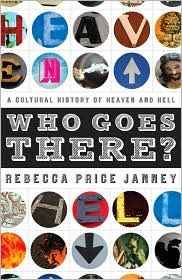
Who Goes Where There: A Cultural History of Heaven and Hell (Review)

When reviewing a book, there are many questions that I ask whilst reading. Some examples:
What is the author's thesis?
Does the author effectively work from/towards that thesis?
For what audience is the book best suited?
What are the negatives and positives about the work?
And what/how does this book add to the ongoing dialog of the Christian faith?

In Rebecca Price Janney's Who Goes there: A Cultural History of Heaven and Hell, I felt that her premise was 2 fold. One, to explore the attitudes of Heaven and Hell during different time periods in our nation; and two, to explore WHY the attitudes and theologies have changed over time. I have mixed opinions about whether she achieved these objectives or not. I think that she began this book with those two premises in mind, but quickly lets it give way to concluding that most people simply have poor theology on Heaven and Hell, and it has been that way for a while!

I'll begin with premise #1. Janney gives an American snapshot of the trend in our history to change our opinions on the subjects of the afterlife. She is very unbiased towards the fact that there was once a time when the majority (and I question her use of the word "majority") had "solid theology" on the subjects of Heaven and Hell. When was this time? Well it was none other than The First Great Awakening. Known for such tent/traveling preachers as Wesley, Whitefield, and Edwards, this was a booming time of what has become known as "Hell-fire and Brimstone Preaching". These preachers would come into town, set up shop, and people would flock to these events and buy whatever was being sold. I say that tongue-in-cheek, but let's think a little about the lifestyle of that time period.

Moral was low, the death-rate was high, all day was spent working (usually manual labor), and money was scarce among the masses. Who can blame people for flocking to an invitation given by one of these great orators that either 1) played on their already present fears, or 2) gave them a beacon of hope. People were wooed by these educated preachers because education was also poor in America at this time. It's not that dumb people fall for these messages, in fact I think it is that these average people longed for better understanding and education and "learned" from these people these doctrines they were pandering. Who would blame them? It makes complete sense that people thought more about Heaven and Hell at this point in time than any other since.

But for Janney, those were the "good old days". Americans have produced nothing but poor views on the subjects since. She chastises those who's understanding of Heaven is that "everyone good gets to go, except child-molesters and Hitler." I started thinking about this and I have to say, in all my years involved with churches and my time in ministry, I have NEVER once even heard a preacher say at a funeral, "well, Clive was a good guy, but since he never accepted Christ.... well, Clive's off to Hell now." It's not just the American populace and laity that think that people deserve to go to Heaven, even some of the most conservative ministers deep down do not act this out practically. Only when it is a concept from behind a pulpit, when we don't put faces to the concepts (except Hitler?!) is this taught with the utmost certainty.

But Janney doesn't mention this. And because she fails to accurately discover why most people's theology on the afterlife have changed, I feel that this book is truly not worth the read. Please understand, it has nothing to do with whether or not I agree with her theology on the subject! I don't recommend this book to anyone because she doesn't stay on her thesis, she is completely biased to the fact that any theology but her own is poor, and she truly misses out on a fantastic opportunity presented by this book. That opportunity comes with my last question I ask of a work:

What or how does this add to the ongoing conversation in our Christian faith?

I think that there are 2 thoughts that I conceived from this book.
1) There is a trend by many Christians, especially postmodern Christians, to NOT talk about the afterlife. I don't think its fair to say that theology has gotten weak, in fact, there has been some great theological thoughts on Salvation and the afterlife (both new and reclaimed) that has come out of this shift. But since the Heaven/Hell theology has been forced down many people's throats at the expense of equally important messages of Christ, there is a tendency to shy away from talking about or tackling the questions that people still have about the afterlife. We must focus on a holistic view of following Christ, and that means not ignoring any of these issues about which the Bible speaks. Janney, sort-of leads the reader to this conclusion, but sacrifices the calmer message for that of denouncing any theory of the afterlife except for the single one to which she herself adheres.

2) I think this is the more important question that Janney totally misses her opportunity on. When you have billions of people in the world, (Janney never really looks past the American geographical boundaries, but the phenomenon of which she speaks is world-wide) and over the past 100 years (or more) this idea of a different Heaven has emerged and held tight: the idea that it isn't about accepting Christ, but something bigger. That Heaven is a place that people deserve after the hell of this life, or because they are good people, or the myriad of the other beliefs out there. When are we going to let these theological concepts (and yes they can be considered theology, that one branch of Christianity does not have a patent on thinking about Heaven and Hell) dialog with more "traditional" ideas of the afterlife? If we believe that God is still at work and revealing himself...if we believe that theology is as Daniel Migliore defines it: "Faith seeking understanding," then we owe it to our own beliefs and certainties to face these challenging thoughts and questions. Who knows where it will lead us? I think we would find that these thoughts are far from "poor theology", and in fact, be shocked to find how well thought out and developed these ideas are.

When we push people and thoughts like this aside for our own "certainty", we miss out on many opportunities. I think this sums up Janney's book...a missed opportunity!

Find more reviews here!
Previous post w/ media here!

Feel free to leave any thoughts!