Thursday, April 16, 2009

Elizabeth Warren on the Economy

An interview with Elizabeth Warren on last night's Daily Show.
I thought this was a good and one of the most educational and informative interviews out of all the "experts" that have been interviewed on any network/show. Perhaps it is because I feel like finally someone is being honest with us (good and bad), as well as keen insight on the economic trends through history, and on the precipice that we are on economically RIGHT NOW!

The Daily Show With Jon StewartM - Th 11p / 10c
Elizabeth Warren Pt. 1
thedailyshow.com
Daily Show
Full Episodes
Economic CrisisPolitical Humor


The Daily Show With Jon StewartM - Th 11p / 10c
Elizabeth Warren Pt. 2
thedailyshow.com
Daily Show
Full Episodes
Economic CrisisPolitical Humor


I think, like John Stewart, that after this, this is the first time I have felt a little better...can we say possibly...hopeful?

I also like Warren's text called "The Vanishing Middle Class" in the book, Ending Poverty in America: How to Restore the American Dream, which is an issue close to my heart (at least the widening gap between the wealthy and the poor). As is stated in the book, I think the issue of the emerging gap and polarization between classes and the issue of poverty go hand-in-hand...not just in America, but also on a global scale!
Any thoughts?

Tuesday, April 14, 2009

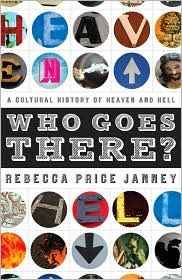
Who Goes Where There: A Cultural History of Heaven and Hell (Review)

When reviewing a book, there are many questions that I ask whilst reading. Some examples:
What is the author's thesis?
Does the author effectively work from/towards that thesis?
For what audience is the book best suited?
What are the negatives and positives about the work?
And what/how does this book add to the ongoing dialog of the Christian faith?

In Rebecca Price Janney's Who Goes there: A Cultural History of Heaven and Hell, I felt that her premise was 2 fold. One, to explore the attitudes of Heaven and Hell during different time periods in our nation; and two, to explore WHY the attitudes and theologies have changed over time. I have mixed opinions about whether she achieved these objectives or not. I think that she began this book with those two premises in mind, but quickly lets it give way to concluding that most people simply have poor theology on Heaven and Hell, and it has been that way for a while!

I'll begin with premise #1. Janney gives an American snapshot of the trend in our history to change our opinions on the subjects of the afterlife. She is very unbiased towards the fact that there was once a time when the majority (and I question her use of the word "majority") had "solid theology" on the subjects of Heaven and Hell. When was this time? Well it was none other than The First Great Awakening. Known for such tent/traveling preachers as Wesley, Whitefield, and Edwards, this was a booming time of what has become known as "Hell-fire and Brimstone Preaching". These preachers would come into town, set up shop, and people would flock to these events and buy whatever was being sold. I say that tongue-in-cheek, but let's think a little about the lifestyle of that time period.

Moral was low, the death-rate was high, all day was spent working (usually manual labor), and money was scarce among the masses. Who can blame people for flocking to an invitation given by one of these great orators that either 1) played on their already present fears, or 2) gave them a beacon of hope. People were wooed by these educated preachers because education was also poor in America at this time. It's not that dumb people fall for these messages, in fact I think it is that these average people longed for better understanding and education and "learned" from these people these doctrines they were pandering. Who would blame them? It makes complete sense that people thought more about Heaven and Hell at this point in time than any other since.

But for Janney, those were the "good old days". Americans have produced nothing but poor views on the subjects since. She chastises those who's understanding of Heaven is that "everyone good gets to go, except child-molesters and Hitler." I started thinking about this and I have to say, in all my years involved with churches and my time in ministry, I have NEVER once even heard a preacher say at a funeral, "well, Clive was a good guy, but since he never accepted Christ.... well, Clive's off to Hell now." It's not just the American populace and laity that think that people deserve to go to Heaven, even some of the most conservative ministers deep down do not act this out practically. Only when it is a concept from behind a pulpit, when we don't put faces to the concepts (except Hitler?!) is this taught with the utmost certainty.

But Janney doesn't mention this. And because she fails to accurately discover why most people's theology on the afterlife have changed, I feel that this book is truly not worth the read. Please understand, it has nothing to do with whether or not I agree with her theology on the subject! I don't recommend this book to anyone because she doesn't stay on her thesis, she is completely biased to the fact that any theology but her own is poor, and she truly misses out on a fantastic opportunity presented by this book. That opportunity comes with my last question I ask of a work:

What or how does this add to the ongoing conversation in our Christian faith?

I think that there are 2 thoughts that I conceived from this book.
1) There is a trend by many Christians, especially postmodern Christians, to NOT talk about the afterlife. I don't think its fair to say that theology has gotten weak, in fact, there has been some great theological thoughts on Salvation and the afterlife (both new and reclaimed) that has come out of this shift. But since the Heaven/Hell theology has been forced down many people's throats at the expense of equally important messages of Christ, there is a tendency to shy away from talking about or tackling the questions that people still have about the afterlife. We must focus on a holistic view of following Christ, and that means not ignoring any of these issues about which the Bible speaks. Janney, sort-of leads the reader to this conclusion, but sacrifices the calmer message for that of denouncing any theory of the afterlife except for the single one to which she herself adheres.

2) I think this is the more important question that Janney totally misses her opportunity on. When you have billions of people in the world, (Janney never really looks past the American geographical boundaries, but the phenomenon of which she speaks is world-wide) and over the past 100 years (or more) this idea of a different Heaven has emerged and held tight: the idea that it isn't about accepting Christ, but something bigger. That Heaven is a place that people deserve after the hell of this life, or because they are good people, or the myriad of the other beliefs out there. When are we going to let these theological concepts (and yes they can be considered theology, that one branch of Christianity does not have a patent on thinking about Heaven and Hell) dialog with more "traditional" ideas of the afterlife? If we believe that God is still at work and revealing himself...if we believe that theology is as Daniel Migliore defines it: "Faith seeking understanding," then we owe it to our own beliefs and certainties to face these challenging thoughts and questions. Who knows where it will lead us? I think we would find that these thoughts are far from "poor theology", and in fact, be shocked to find how well thought out and developed these ideas are.

When we push people and thoughts like this aside for our own "certainty", we miss out on many opportunities. I think this sums up Janney's book...a missed opportunity!

Find more reviews here!
Previous post w/ media here!

Feel free to leave any thoughts!

Monday, April 13, 2009


Jeffrey C. Pugh Speaks to my boy Tripp Fuller about his new book: Religionless Christianity: Dietrich Bonhoeffer In Troubled Times. I think this is a great podcast that you should listen to. Done with the love and care of all of Homebrewed's podcasts, this one shifts some thoughts about Bonhoeffer's genius and how it would apply today in a post-Christian shift.


A thought-provoking and challenging series of thoughts!

Tuesday, April 07, 2009

Jesus, Interrupted (Preview)

Dr. Bart Ehrman, professor of Religious Studies at UNC Chapel Hill, has written several books that often cause a lot of conversation (and sometimes controversy) over the years. My first experience with him was reading Lost Scriptures (and its companion Lost Christianites) in my New Testament class. He deals with the books and manuscripts left behind in the canonization process of the NT. This book was an eye-opener for me because it made me (and through me, my class) ask the question, who gets to choose which version of Christianity "makes it" into the bible. There are many other traditions in our early Christian history that have all but been silenced though the canonization. One big question that this book made us wrestle with was, "did in fact the 'winners' get to choose our Christian beliefs, and what did we lose when we lost the views of the 'losers'?" Now many people will argue (and have argued...a lot!) that the process (which was messy and happened over a long period of time) brought forth the "true" scriptures and the heretical scriptures were weeded out. After reading many of those "weeded out" texts one begins to wonder what exactly we have lost in declaring them the "losers"? In essence, at that period in our history all of these groups and writings were struggling with the same questions: "Who was Jesus?", "Who are we as followers of Christ?" and "What exactly does it mean to be 'the Church'?". The answers may vary, but the questions are some of the same questions we struggle with today!

Among Ehrman's other publications, his most talked about have been Misquoting Jesus, where he explores the translation and preservation (copying) process and how that has impacted the Bibles we hold today. He sheds light on how messy and inexact the process is, and how what we read may not have been in the original texts.

His last book, God's Problem, dealt with the questions of pain, suffering and evil and how it is or isn't present in the Bible. Both of these books have brought equal amounts of praise and scorn from their readers. However, What I admire most about Ehrman, is that he brings these issues, which are commonly talked about in the world of Christian academia, and delivers them to the pews. Many people who read these publications (which are highly accessible to the average reader) are forced to ask, "is this true?" and, "Why have I never heard this talked about in church before?". Ehrman peels off the outer layers of the surface religion that is so common in American Christianity, and forces the reader to encounter, question (I would argue in a good way), and converse with the deeper parts of their own faith, assumptions, and beliefs. While I myself may not always agree with his conclusions, I highly respect and encourage his works and the dialog opportunities that they offer!

His newest book, Jesus, Interrupted: Revealing the Hidden Contradictions in the Bible (And Why We Don’t Know About Them), is on its way via snail mail, and I will be reviewing it within a month of receiving. Until then, as with the last post, I offer these materials to help get us all pumped for the book.

This is a blogalouge debate on the problem of pain and suffering between Ehrman and NT Wright, also a revered New Testament Scholar.
This is a video:


And if all that doesn't tide you over, I don't know what will.
What are your thoughts on the books you've read by Dr. Ehrman?

UPDATE: New Media
Ehrman's Interview on Colbert
The Colbert ReportMon - Thurs 11:30pm / 10:30c
Bart Ehrman
colbertnation.com
Colbert Report Full EpisodesPolitical HumorNASA Name Contest

An Ooze.com Viral Blogger post.

Thursday, April 02, 2009

Heaven and Hell...Who Goes There?

I thought as I prepare to read and review a book for TheOoze.com, I would give pump you (and myself) full of expectations. Well, actually that's not how I work in trying to remain objective, but I do like it when I can pump up an excitement for a book while limiting my own exposure to opinions of the work before I form my own. So here's some resources for the book I have been sent:
Who Goes There: A Cultural History of Heaven and Hell By Rebecca Price Janney

A promotional Video:


Here's a SAMPLE EXCERPT (PDF-16 Pgs) for your own enjoyment.

Stay tuned for the review...

Wednesday, April 01, 2009

Is The Economic Crisis Good For America?

First off I want to apologize for not posting the last 2 weeks. Believe it or not, I've been doing A LOT of thinking and writing (in note form), but have not had time to really sit down and hammer out my thoughts in an a more reader friendly format. Don't worry, I have much on mind that I hope I catch up on here soon. Interestingly enough, a lot of the thoughts I have are all converging. Once I am ready to tackle these thoughts, new ideas and/or circumstances cause me to take a step back and ponder more!
---__---

The center of a lot of my thinking of late centers around the global issues that plague our world. With issues like global poverty, hunger, war, social justice, oppression, slavery, etc... always near the front of my mind, I have found myself thinking less about what we/I can do (even though that is always a big concern for me) and more about what causes and perpetuates these problems. This has a lot to do with our Bible Study Community reading and discussing Brian McLaren's Everything Must Change. In this book he tackles the systems that keep us from solving these global problems. More on that in another post.

With this at the front of my mind, along with the economic situation, I see this week's Time
Magazine with the cover story, "The End of Excess: Why This Crisis is Good For America" (click on link to read the full article). There are some interesting things pointed out.
We saw what was happening for years, for decades, but we ignored it or shrugged it off, preferring to imagine that we weren't really headed over the falls.....Even smart, proudly rational people engaged in magical thinking, acting as if the new power of the Internet and its New Economy would miraculously make everything copacetic again. We all clapped our hands and believed in fairies.
The popular culture tried to warn us. For 20 years, we've had Homer Simpson's spot-on caricature of the quintessential American: childish, irresponsible, willfully oblivious, fat and happy. And more recently we winced at the ultra-Homerized former earthlings of WALL•E.
The article goes on to say:
We are like substance abusers coming off a long bender, hitting bottom (we can only hope) and taking the messes we've made as a sobering wake-up call. I've always thought many of the 12 Steps were superfluous, so here is a streamlined, secularized Three-Step Program for America — Bubbleholics Anonymous? — to start getting back on track:

• Admit that we are powerless over addiction to easy money and cheap fossil fuel and living large — that our lives had become unmanageable.

• Believe that we can, individually and collectively, restore ourselves to sanity and normal living.

• Make a searching and fearless moral inventory of ourselves and be entirely ready to remove our defects of character.
Unfortunately, those steps are only a start, but the article shines with hope...at least for some people. Others (the addicts that are in denial or want to remain addicted to our "prosperity, security, and equity systems" (EMC)) will find this a judgement of damnation in their lives. For me, although this economic crisis hurts, (I like my comfortable consumerist life), I see a hope that this is the breaking down of those addictive systems. I hope that this helps break us out of our collective greed bubble and will help us focus on the role we, as the wealthiest nation in the world, can play in solving these global crises.

We've already seen it. When gas prices get too high we start looking into more affordable vehicles and learn about our carbon footprint and begin to focus on the environment. However, as gas prices dropped, we once again looked longingly at the newest H2. No, our addictions are much deeper and a bigger intervention is required. Perhaps an economic meltdown is the kind of intervention we need! Trust me... it hurts me to say that. It also scares the living snot out of me!

However, we can do it...."Yes we can!" We can break free of our suicidal systems and addictive habits and begin to see past ourselves into a bigger world; a world where there are a LOT of issues that we need to deal with. Its not just about helping others, its about helping ourselves. Its about working for the good of the collective, not just working for our own good.

Poverty, AIDS, Hunger, War and Peace, Social Justice, Equality, the Environment, Etc...

These are American issues. By that I mean these are issues about which Americans should be concerned. By ignoring these issues and denying "the American dream" ideal to the world, we have lost our own identity as a great country!

These are also spiritual issues! While we've been in our own secure little bubble where our biggest concern is safeguarding ourselves at the expense of others, we've been losing our very soul! We would sell the very essence of who we are...who we are created to be. All for excess. How? Because we are all connected. we are connected to the abused, malnourished, mistreated, and alienated human-beings that we've all been ignoring for far too long. We are all created in the image of God...referred to as the children of God. Yet we've been ignoring our own siblings.

This is why I see hope in this article. Don't question my patriotism, I love America! But perhaps this is the kick in the pants we all need to see past ourselves and to begin living for something other than ourselves...something BIGGER than ourselves!

What are your thoughts?

Friday, March 13, 2009

QotW

Several "Quotes of the week" that I really like

first from U2's new CD No Line ON The Horizon
I can stand up for hope, faith, love
But while I’m getting over certainty
Stop helping God across the road like a little old lady

Out from under your beds
C’mon ye people
Stand up for your love

Love love love love love…

I gotta stand up to ego but my ego’s not really the enemy
It’s like a small child crossing an eight lane highway
On a voyage of discovery
Also:
Its not if I believe in love
If love believes in me
And from John Philip Newell
I do not believe that the gospel, which literally means "good news," is given to tell us that we have failed or been false. That is not news, and it is not good. We already know much of that about ourselves. We know we have been false, even to those whom we most love in our lives and would most want to be true to. We know we have failed people and whole nations throughout the world today, who are suffering or who are subjected to terrible injustices that we could do more to prevent. So the gospel is not given to tell us what we already know.

Rather, the gospel is given to tell us what we do not know or what we have forgotten, and that is who we are, sons and daughters of the One from whom all things come. It is when we begin to remember who we are, and who all people truly are, that we will begin to remember also what we should be doing and how we should be relating to one another as individuals and as nations and as an entire earth community."
(This came from a response to Tony Jones' Blog Post)
Just some thoughts to think about!

Thursday, March 12, 2009

Exploring Framing Stories(Part 3): Where do they come from?

I was recently asked, concerning my last post, to address from where framing stories come?

This is a tough question to answer in the confines of a blog post, so know that this is not comprehensive. However this should give one a good idea. Let's take a step back away from religious framing stories for a second. EVERYONE has a framing story (or sets of framing stories) that inform and affect their lives. Our individual framing stories are a mix of genetics and environment. Our framing stories are passed down from our families, education, culture, experiences, etc...

These framing stories inform our decisions, personality, preferences, and well... everything about us. We can't escape our framing stories, for without them we wouldn't be who we are!

Now back to religious framing stories. I'm going to stick to the overly-simplistic examples used in the first post of this series: the conventional and emerging.

We develop our faith/religious framing stories as we grow up. We inherit these frames from our church experiences (or lack of), our parent's/families' faith, and the religious culture from which in which we are exposed. We also feed back into this frame and culture. It also should be mentioned that our overall framing stories impact our religious FS, and visa-verse. It is truly a tangled web. Studies show that the #1 place from which we learn our faith practices are our parental figures. Church actually appears 3rd on the list.

Please understand that a person can inherit EITHER (or any) FS, not just the conventional. It just happens that in American Christianity, the conventional FS is the one that is inherited.

However, I think that although understanding where these FS originate is important, the question that is MORE important is WHY are so many people choosing to move away from their original Framing Story?

I use the work "choose" loosely. For the majority of people it is not a conscious decision to transition from the inherited framing story into a new one. Yet many (more every day) are realizing that they are indeed emerging out of and away from their original FS. The factors that inform this happening are as complex as are the factors that make up our original FS. In fact, the easiest way to understand WHY and HOW people move away from their original FS are the SAME factors listed above that inform their original FS. What changes? The overall frame. They move away from their family, they experience new cultures and cultural surroundings. They break free of the bubble of thoughts and ideas into a new surrounding. They explore their own thoughts, world, and beliefs through higher education (not just a college degree, but education derived from new experiences). What they are finding is that the conventional FS does not do a good job addressing the "new" reality in which they now find themselves. A reality that has always been there, but was outside of their spheres of influence as a child.

There is a lot we can learn from other's FS. Everyone's journey is unique to them. The greatest thing we can do is listen and share in each other's journeys! This will help us to understand each other's FS's, and hopefully, will help churches to embrace and even encourage people to explore and question their own framing stories. The pews should no longer be a place of forced conformity, but full of people who are diverse in their experiences and FS's, willing to listen and willing to share. Otherwise, I fear that the Church will not survive, or at least thrive, as more and more people continue to move away from the conventional FS (the one that most mainstream churches cling to), towards the emerging FS that addresses their reality.

Monday, March 02, 2009

Thoughts From A Wanderer

My friend, Mary, has 2 fantastic posts over @ Not All Who Wonder Are Lost. The first one I want to link to because I want to give her credit. We are all part of the same Bible study community, and spicifically one of her comments that she made (repeated in the post A Square Peg Goes To Church) inspired the thought pattern that led to me last posts.

This comment from Mary spicifically led me to my last posts:
I realized last week, that my framing story for God, theology and the body of Christ is NOT the same as many of those in my church. I kinda figured that out a long time ago, but it really became explicit for me. That realization helped me at least articulate why I felt like the square peg.
It is a good glimpse at how some of our conversations go, and how we bring our own experiences into our group to share and discuss. We have come up with some amazing questions and thoughts!!! Check it out, it's worth the read.

Also her newest post: Pro-Life=Pro-Baby was a direct comment from her tonight.

I post these links, not only to link to some good thought-provoking material, but also because I am proud to be in a group that 1) thinks critically about their faith, 2) lives and learns within the questions, and 3) (most importantly) is a free place to share one's thoughts, struggles, and disagreements openly and freely with a group that practices love and encouragement.

It is proving to me a point that many confrontational Christians have disagreed with me, that UNITY IS NOT CONFORMITY... instead it is acting in love and respect towards one-another regardless of our differences. We all acknowledge that we are broken people doing our best to become fully human (in all that means), and/or to become the person into whom God is making each of us!

We (Christians in churches) spend a lot of time alienating people who feel like "square pegs" instead of listening and learning from each other. What we would realize is that there is a communication problem...different framing stories mean we are speaking different languages! More and more people are finding that their framing story is not matching up with that of the conventional framing story as presented by the modern Church. The next question that led to my post from this was, "how then do we move forward in love once the problem has been diagnosed?" And thus we get to where the framing story posts have led thus far.

We keep splitting, pushing, and running away, but I'm here to tell you that:
IT IS POSSIBLE PEOPLE! :)
And I'm grateful to be a part of where it is happening!

Thank you Metavista Bible Study Group!!!!

Thursday, February 26, 2009

Exploring Framing Stories(Part 2): Trying To Move Forward!

In my last post we looked at the idea of "framing stories" and the 2 general framing stories that are alive in western Christianity. However, what happens once you define and establish which framing story (conventional, emerging or another), and you then find yourself at odds with other framing stories.

Using the examples from last post, the Conventional Framing Story is finding itself more and more at odds with the general public. Why? There are many reasons. What it most generally boils down to is that someone grows up exposed to the conventional framing story, but because of new experiences and education (not meaning formal ness., simply education that comes with experiences) when leaving home and the overwhelming influence of the conventional framing story. In other words, they experience a new and different reality. It can come from college classes, a change in lifestyle, visiting another country, studying global issues, or simply physically removing themselves from the conventional bubble they were accustomed to.

However it happens, more and more people are connecting with the emerging framing story(EFS). Those that cling to the conventional framing story(CFS), fight hard to hold control and power within that context. This leaves those in the new(yet I would argue more ancient/orthodox FS), in a conundrum. They are drawn into these arguments and thus the last 10 years that we have seen this EFS come to fruition has been riddled with debates and arguments. Alas, we are beginning to see that this way of doing things is getting us nowhere.

There is still this problem: we know that there are many people within the Church that are dissatisfied with the form of religion being fed to them, but are unaware that an alternative FS exists. Then there are those outside the Church that are not in connection with anyone who can offer them the emerging framing story. Thus they are left thinking that Christians only care about Heaven, hell, and fire insurance while ignoring the global issues of the day!

However, this EFS seeks to reconcile all of Christ's teachings and Biblical themes in the lives of people. This means that Christ has once again become our example Christian prioritization. Christ was most concerned about helping others. McLaren and others argue that Jesus himself came offering his 1st century contemporaries a NEW FS! In he midst of an empire that marginalized many and enforced their version of peace, the Pax Romana. There were many Jewish sects that fought over the right way to approach this empire that was suffocating them (Pharisees, Zealots, Essences, etc...), however Jesus came in to offer another way...God's way! And this new view offered by Jesus was the only way for which true peace and equality could be achieved. This is the FS that the EFS seeks to work within. One that cares about what Christ cared about, who seeks to follow his teachings and examples of life, not just the afterlife.

But what do we do? What comes next? Here we are with this EFS that is vital and relevant in today's world, and yet most of those that fall under the banner of "Christian" have not been exposed to this new option. Do we continue to fight? Do we campaign? What?

Again, let's look to Christ for an example.

Here was Christ, holding this new FS which was vital to the world, and he went low key. He didn't fight (although he had many chances). Instead he TRAVELED! He went from place to place teaching and showing what this new FS looks like. Along the way, he picked up more and more people who caught on and were captivated by this new FS. Yet, he didn't walk aimlessly. He walked TOWARDS the reality of seeing this FS come to fruition. He traveled TO the cross! Along the way he simply invited others to join in his journey. He never showed hatred, or acted non-compassionately towards those that didn't get or agree with his new FS. He simply, like the "Rich Young Man", allowed them to continue on their way. He allowed them to keep practicing what they felt was right, while continuing to live the life of this new FS.

A life of love,
Of Service
Of Sacrifice
Of Giving
Of Equality
Of Hope
Of Peace....

This is the EFS...The same FS we see in Christ!

Thoughts?

(Painting by Greig Leach: Jesus Washing The Disciples Feet)

Monday, February 23, 2009

Exploring Framing Stories(Part 1): What Are They?

As a photographer, one thing that you consider when taking a picture is what's called framing.  Framing Is deciding how to take the picture that best tells the story that you want to tell.  The picture here is one that I snapped while kayaking down the Colorado River on the Nevada boarder.  I decided that I wanted to capture the landscape and water, but I also wanted to frame the picture so that it told the story that we were kayaking in the middle of the beauty.  I also wanted it to tell the story that I was not alone, so I snuggled my kayak up next to my wife's (as close as we could get) to try and show the beauty and intimacy of our trip.  In other words, the story that I wanted to tell in the framing was that my wife and I were sharing in this beautiful experience in nature.  I know that myself and my wife are outside of the frame, but that is on purpose.  Framing stories don't always give away the full details at first glance.  

My Bible Study Group has been reading Brian McLaren's Everything Must Change on Sunday Nights and discussing it.  I have gotten far more out of the book this second time of reading because of 1) paying more attention to the details, and 2) because of the wonderfully insightful comments that have come from members of our group.  

One thing we talked about last night was the idea of the Framing Story: The story that informs how we understand and interpret life, culture, and religion.  Just like the picture analogy, the way that our story is framed and focused determines how we act and react to the world.  McLaren uses an example of 2 different religious/Christian framing stories.  

Conventional Framing Story: This says that basically we are all a sinful product of the choice of our Adam and Eve ancestors, and that we are all doomed to eternal punishment in hell because of this "original sin" and our "sinful nature".  Therefore, Jesus came to save our souls from hell and give our undeserving selves a chance to go to heaven because he took the place for us on the cross and through his resurrection and defeat of death.  However, this "grace", although offered to all, is only given to those who fall into the "selected category" (this is both the Calvinist view of predestination, and the view that only those who become a part of the selected religion, "Christianity").  "This is the Good News

In this framing story, the purpose of Christ was to "solve the problem of original sin, meaning that he helps qualified individuals not be sent to hell for their sin or imperfection.  In a sense, Jesus saves people...from the righteous wrath of God, which sinful human beings deserve because they have not perfectly fulfilled God's just expectations, expressed in God's moral laws.... Those who receive [offered grace] enjoy a personal relationship with God and seeks to serve and obey God, which produces a happier life on Earth and more rewards in Heaven".  (EMC pg. 78-79)

Emerging Framing Story: God created the world as good, but human beings have rebelled against God--both as individuals and groups-- and filled the world with evil and injustice.  God wants to heal humanity and the world from its sickness.  Left alone, humanity would spiral downward in this sickness and evil.  

Jesus came to address the question, "What must be done about the mess we're in?"  This question refers to the general state of the world as well as the specific context of "his contemporaries" living under domination of the Roman empire and the need for liberation.  

"Jesus' response to this says, 'I have been sent by God with this good news--that God loves humanity, even in its lostness,...God graciously invites any and all to turn from his or her current path and follow a new way.  ...You will be transformed, and you will participate in the transformation of the world, which is possible, beginning right now.' This is the good news. Jesus came to be the saviour of the world, meaning he came to save the earth and all it contains from its ongoing destruction because of [humanity]."(EMC pg. 78-80).

As part of his transforming community, we can experience liberation and participate in the liberation of others.  We can be partners in God's "global transformation and liberation," as well as deliverers of hope and justice.  
_--__--_-_

So here we are with 2 Christian Framing Stories.  It's kind-of like the picture.  I have other pictures taken where I zoomed in on the landscape.  The story that those frames tell is that I saw a canyon with  river.  But when I zoomed out and reframed the picture into its original context, we find that there is far more to the story than a pretty landscape.  We see a narrative form that involves a more accurate perspective: that we were actually floating on that pretty river between the canyon walls, which is a completely different experience altogether!

This is the same with looking at these different framing stories.  Many people are forsaking religion and church because they are working out of a different framing story than the conventional one put forward by our religion.  One that perhaps has zoomed in way too tightly in it's focus so that we've only been focusing on a portion of the picture.  Framing Stories are important, and I want to focus more on that in a second post.  

For right now, what do you think about "framing stories"?  What are other framing stories that you see or have experienced?  What does it mean when we are working with multiple framing stories under the same religion?   Where does this mean we go from here?

I know this is 101 for many people, but I am finding more and more people that need to hear this because they haven't heard it before.  I'll speak more about that in my second post.  

Your thoughts!

(Photo by Justin Bowman)

Sunday, February 08, 2009

Hope is Crazy!


Brett Dennen - Make You Crazy (Feat Femi Kuti) 

You Know, It`s hard to be Yourself,
Free Yourself, To see Yourself,
When all around You there are Lies just to get You,
Spies just to get You, To Buy so they can get You

There are Cameras in the sky, Lasers in our Living rooms,
There are Wolves watching wearing Sheep`s Costumes

It`s Enough to make You go crazy (woah)
It`s Enough to make You Mad
It`s Enough to make You go crazy (woah)
And, I`m amazed I Haven`t yet

Isn`t It, A Shame The way We cheat Each other, 
Treat Each other, Beat Each other??

It`s, A Shame The way We use One other, 
Abuse One another
And, Screw One another, It`s true.

They will Lock You up in Prison, But They won`t call it slavery, 
There are stolen Children raised and Trained in Armies

It`s Enough to make You go crazy (woah)
It`s Enough to make You Mad
It`s Enough to make You go crazy (woah)
And I`m amazed I haven`t yet

Don`t hesitate to speak Your Mind? (speak Your Mind)
Never hesitate to speak Your Heart? (speak Your Heart)
They`ll call You crazy, When You speak Your Mind? (When You speak Your Mind)
So never, Never hesitate? (never hesitate)

`cause It`s Enough to make You go crazy? (woah)
It`s Enough to make You Mad
It`s Enough to make You go crazy (woah)
And, I`m amazed I haven`t yet
__________

This guy is worth checking out!  If you haven't already, Brett has become one of my fav. artists over his 3 albums.  He sings a LOT about things I truly care about: 
Hope
Love
Acceptance (of yourself & each other)
Awareness of the atrocities going on around us, and how we're in a position do actually better this world.  

Check Him Out!!!!!
"Ain't No Reason"