Showing posts with label Faith. Show all posts

Wednesday, November 24, 2010

Jesus: Communist or Capitalist?

I get into this discussion a lot. It is kind-of the idea of the old WWJD; which would Jesus advocate for more: Socialism or Capitalism. It is tough. There are a lot of passages and examples from the teachings of Christ and the early Church that make a lot Christians who are social activists to answer: socialist. However, there are other passages that would make one argue against that.

Even pulling the Bible out of the picture, this has been an ongoing philosophical battle for decades in the US. I am a big fan of Ayn Rand and her Magnum Opus: Atlas Shrugged. It is perhaps the most comprehensive philosophical and narrative argument for Capitalism. However, it is an idealized Capitalism, not an actual one. I struggle with her theories in my head because that is the only place her reality has existed. Socialism, on the other hand, shares much of the same story. Socialism DOES NOT = COMMUNISM. There is a difference. I think that socialism is another "ideal" that has yet to be realized. Both, in my humble opinion, have their strengths and flaws in the utopian philosophical arguments.

However, CNN has a post that puts these two ideas in debate. I DO beyond a doubt think this is a great discussion for Christians and the Church to have. However, as much as I like this conversation, I must remember that Jesus was BEYOND either systematic thesis. The Kingdom of God (again IMHO), is bigger than this. But, if we want to bring about the Kingdom of God on this earth, then we have to do so with the systems that are in place. Wether it means subverting a specific system or embracing it, we have to use the best of it to heal while we in turn, heal the broken parts of our system.

It seems to many (I'm not sure I agree) that our government is sliding into a more socialist identity. While this is not a political blog, I'm not sure that some synthesis of the best parts of a socialist and capitalist mindset are truly at odds. A government's job in the USA is to protect and care for it's people. I'm not sure how you can do this with an Ayn Rand type of Capitalism. Then again, we have yet to have a truly successful Socialist experiment without the corruption and disenfranchisement of the people. Yet as a Social Conscious Christian, I find myself asking, "in what areas would a more Capitalist/Socialist approach truly do things like:

End Poverty
Alleviate corruption in government (this must be done, not to be political, but because to truly heal a situation, the system itself that is causing or at least allowing oppression, must be fixed).
End World Hunger
Give equal rights to all men and women
AND THE LIST GOES ON......

In any case, as always I have more questions than answers to offer. So in my offering I give you the link to the following debate/article and the video clips.

CLICK FOR ARTICLE


Enjoy, and please feel free to leave comments.

Friday, October 15, 2010

How To Be Nasty Religiously (A repost)

This if from a person I have followed since I first began blogging, David Hayward. I have shared a lot of his art over the years, but he is far more than a talented artist. He is an insightful minister and human-being. You can find his blog here.

I found this post to be very insightful and thought-provoking. As I was taught in Kindergarten, it is always good to share! Check out his blog for more!
____________________

I realize mind-games and manipulative behaviors go on in every sector. But what I’ve experienced is that when someone is nasty in the work place, they are just nasty, it is recognized as such, and called for what it is. Usually. Not always.

But what I’ve noticed over the many years in the church, in spirituality, in Christianity, is that the nastiness in religious domains is more subversive. Christians, I’ve concluded, generally want to be nice, sincere people of faith. They would never want to hurt anybody.

So when something upsetting happens to them against their will, rather than get consciously angry, mean, manipulative or deceitful, they drive these unpleasant thoughts and feelings deep underground and cover it all in a sentimental spirituality laced with ultimate concern for the church, God’s will, and mission.

What actually happens is this psychologically separates the unconscious drives from the conscious ones, allowing the unconscious ones to bloom with full sanction under the guise of genuine concern. Anyone with any discernment can see the monstrosity of the person’s thinly veiled ulterior motives, lack of honesty and integrity. But the person himself is completely blind to them. His spirituality won’t allow him to recognize it. He lacks integrity. In other words, he is not an integrated person. He is not integrating his unconscious with his conscious, his dark side with his light, his sinner with his saint.

To address the issues head-on would fall on shocked, offended and deaf ears. It is useless. Unless a close friend or relative points it out. Then maybe. Otherwise, from my experience, it takes the mortifying trauma of an understood bad dream, a revelation, self-awareness, or realization (whatever you want to call it) for it to be addressed. Plus humility.

Monday, July 19, 2010

Don't Believe Everything On TV

Glenn Beck took on Liberation Theology and does a pretty poor job of representing the theology.
Take a look:


This bothers me, not because Beck is not entitled to his opinion, but because this was a gross misrepresentation of the complex study that is Liberation Theology! The clips of James Cone is taken out of context and then twisted to fit into Beck's political agenda. It is amazing to see how much he warps scripture such as "The Good Samaritan" to fit his own ideals. It is simply frightening.

Why?
Because many people (reading comments, blogs, and having conversations on this) take Beck's statements as if he were a true theologian or Biblical scholar. Where does the real problem lie though? Again, Beck is entitled to his opinion, and he is entitled to his voice on his own show. What frightens me most is that there is a lack of solid education going on in many of our faith communities on things such as Liberation Theology.

One reason I was called into ministry, and specifically into teaching in churches, is because I thought it was very sad that I had to go to college and Divinity school in order to get a solid education on what all is out there on scripture and theology. Bringing this same level of education to the laity is a a strong passion of mine and many of my friends and colleagues! It is my hope that when people see something like this on TV, they will think about it, weigh it against what they know based on solid education in our faith communities, find and be led to solid research sources, and know how to formulate their own thoughts and ideas.

Whether it be a charismatic TV personality, or a beloved pastor, or an opinionated blogger; we should encourage and train our fellow brothers and sisters in our communities to not settle for anything less than solid and well-informed education. We should help others to study and share within their communities so that we are having conversations to a more enlightened and responsible faith. This begins with the ministers' encouragement, training and equipping of the laity. Making a safe place of intentional diversity of opinion and encouraging healthy discussion as well as providing solid resources for people to learn more about their topics of interest.

I am a firm believer that you shouldn't simply take anyone's word (no matter how big their platform) as gospel. Instead, we should teach others to take responsibility for their thoughts and beliefs and become well-informed people of faith. Perhaps then we will have productive and more accurate conversations about things like Liberation Theology.

My prayer: that we would up the level of quality of our education in our communities of faith and never settle for anything less than the best!

More links:
Huffington Post (editorial)

Thursday, June 24, 2010

Global Empathy

This video was on The Burner Blog from Fuller Theological Seminary, and I simply can't stop thinking about it. Take a look!


It is interesting to me how we are wired and how empathy is in our nature. In fact it seems to be our default. As my wife said, "this all makes sense and is nothing earth-shattering", yet somehow it is. Why? Because we find empathy so hard! We fight against our very NATURE, the IMAGE in which we were created (IMAGO DEI).

This scientific study and lecture sounds a LOT like the Kingdom of God of which Christ went on about. It IS conceivable that we can reach a level of global empathy, yet we still can't empathize with those people around us. If we can't respond emphatically with our neighbor, how then can we expect to grow into an empathetic relationship on a global scale.

There is a LOT to think on in this video. Ideas of empathy, not only for other humans, but also for all of creation including the planet itself. There is also a lot to ponder when they mention the way institutions we have structured to stabilize our lives push us away from empathy. There is a lot of good thoughts Brian McLaren has on this subject in his book, Everything Must Change.

In any case, it is worth pondering. Too much for me to go into properly, but def. worth a watch or three.

Feel free to comment!

Friday, July 24, 2009

QotW + Cartoons

I apologize for the delay in posting. I've had a lot going on....falling off a 10ft ladder will do that to you! But I did want to post some things that have grabbed my attention in the past week or 2:

1st off, 2 cartoons from artist David Hayward:


Also a quote from Yann Martel (author of Life of Pi), on his faith journey while writing the bestselling novel as found in a recent article in Relevant Magazine:
What's nice about faith is-- once you have it-- it feeds itself; from life, from books, from everything. In a sense, it's a constant dialog.
I like this quote because it really captures the living essence of faith to me. How many people (and I have been guilty of this as well) get settled into one theology or one specific way of looking at God. Like the cartoons above, we only limit ourselves when we forget to place our faith in constant dialog (CONVERSATION) with other thoughts and ideas. And remember a conversation/dialog means listening as much as it does talking. That means taking in others thoughts and giving them the respect they deserve!

Finally a portion of lyrics from the band, Kings of Leon, in their song, Cold Desert:
i never ever cried when i was feeling down
ive always been scared of the sound
jesus don't love me no-one ever carried my load
im too young to feel this old
These lyrics hit me because of many conversations I've had in the last couple of weeks. I have heard several people say something similar to these lyrics, I have read a conversation from Andrew Marin, who works within the GLBT community in Chicago, recount a similar experience. What's sad, is that these comments only come when someone has been severly hurt or has received a great amount of injustice from someone or a group carrying the name of Christ. Think about all of the people groups (not just the GLBT community, although they have a lot of reason to feel this way) that can say this because of a Christian's or Christianity's action or inaction that hurts an individual or people group. Think about how many Christians are responding to the hispanic immigrants in America (legal or not). Certainly many of our words and actions can cause someone to say these things. We've made Jesus' burden far more heavy than he himself claims it to be!

I have to ask myself, who's load am I trying to carry? Who's load are you trying to make lighter? What theology is keeping you from God and others? Who/what are you having dialog with that broadens and enhances your faith? I think there's a lot here to ponder in these few words and pictures.

Leave your thoughts!

Sunday, July 12, 2009

Elevating The Conversation

My community this week is discussing this video. From OozeTV comes an interview with Andrew Marin who has spent a decade of pastoral work in the GLBT community. This interview has a lot of wisdom and insight in it. I never post about the topic of homosexuality because I don't want to be inundated with people fighting over IF it is "right" or "wrong"; "sin" or not! However, I think (and would love to hear your thoughts) that he has some great insight that sum up, stretch and challenge some of my own approaches to this topic. He speaks about HAVING THE CONVERSATION and ELEVATING THE CONVERSATION. Please leave your thoughts, what grabs you, and what perhaps you would like to add or disagree with. Please leave them in a respectful manner!


Original link:HERE

Sunday, July 05, 2009

What Matters More?

New Derek Webb Song. I'm not usually a big fan, but he really hits home on a lot of good points. Also his use of strong language, to me, shows where his passion is even at the expense of his "Christian music audience". I know using cussing in a "CCM" song is taboo, but it really works here. This song gives me hope for the CCM genera of music. Honest and authentic lyrics have been emerging with a lot better music coming from some of the artists.


From Derek's on website, you can see what he's putting on the line (at least hints) to stand up for what he feels in his heart, led by the spirit! Here are copies of the 2 emails:
Email #1 (5/12/09):

friends-
i haven't sent many personal emails to this email list but we're in a situation that has gotten a little out of control and it's time to fill you in. as some of you may know, i've been working for months on my new record, 'stockholm syndrome', which i've recently finished and turned in to the record label. they've been very supportive over the years, but this time we didn't get the response we expected. it seems i've finally found the line beyond which my label cannot support me, and apparently i've crossed it.

i consider this my most important record and am adamant about all of you hearing it. we had originally hoped to have 'stockholm syndrome' out this month (next week even), but at this point we're not sure when the record will come out and in what form. the majority of the controversy is surrounding one song, which i consider to be among the most important songs on the record. so we've decided it's an appropriate time to break the rules.

but because of various legal/publishing issues we're having to be rather careful with how we do what we need to do. that's really all i can say for now and i've probably said too much.

this is our plan and we're moving ahead, but we're not sure what kind of trouble we might be getting into. we'll let you know as soon as we know our next move-
derek

AND
Email #2 (5/19/09):

friends-
this is turning into a bigger deal than we expected. as a result, we're having to temporarily pull everything online down (can't explain now). and to be on the safe side, i'm going to personally go offline while we sort this out. i re_ally shouldn't use my twitter account for now either so don't expect any updates there.

make no mistake, our trouble with the label over content is very real, and not as simple as one word; we're backed into a corner. but we have applied all of our creative resources to this, working furiously to create something that we believe not only subverts any legal issues but should also be a _pretty wild ride.

so this will be the l_ast email for a while. we'll try to leak information via a new twitter account, @syndrome. you're o_n your own so start paying attention. i'll see you on the other side-
derek
Feel free to leave thoughts on the MESSAGE and MEANING of the song (agree or not), as well as the mess he seems to find himself in because of his beliefs. This is similar to what a lot of people (including myself) have experienced as ministers in churches.

PLEASE DO NOT leave a comment chastising me for posting a song with strong language in it. I didn't write the words, so I leave that to artistic creativity on behalf of Derek.

Doubt and Certianty

If you have not seen the movie DOUBT, you really owe it to yourself to rent it. Based on an award-winning play and with 5 Academy Award nominations, this movie is def. a watch, think, and discuss movie.

In the spirit of discussion I post here a portion of Mike Leaptrott's thoughts on the movie. I find this the best and most eloquent insight on the movie, as well as the faith journey, I've read. Check the full post out here at Progression of Faith.
___________
From Mike's Post:
Brilliant movie! The best description I can think of is that it is a postmodern exploration of our sources for knowledge. The movie forces the viewer to ask questions about how we can "know" what it is we feel we "know". How do we come to "feel" certain? Is faith possible without doubt? Is doubt an act of faith? Is a search for truth a journey into the destruction of faith?

All of the performances are wonderful and each character helps us visualize a different foundation for epistemology. For some, our certainty remains in question until we acquire a particular level of evidence. For others, a declaration from some source of authority helps us claim to "know" with certainty. At times, we just can't locate the reasons why we feel so certain. These characters help us see that any search for truth is not a linear path from doubt to faith to knowledge; it's more of a constant interplay between all three. In the end, the movie explores the risks we take when we attempt to locate truth, a search which demands a willful sacrifice of our certainty, a deconstruction of our faith, and a full embrace of our darkest doubts.

Sunday, June 28, 2009

Faith, Hope and Love Pt.1

I've been officiating a good number of weddings the last couple of months and since the passage on love from 1 Corinthians has been read in almost all of them, I have been reflecting a lot on that passage. I have been especially focusing on the last part of the passage: And now these three remain: faith, hope and love. But the greatest of these is love. (1 Cor. 13:13).

It is amazing to me when a passage gets stuck in my head and keeps reoccurring, I begin to hear, see and read things that directly correlate to my ongoing thoughts on theses passages. Perhaps it is serendipity or perhaps it is the voice of God at work through the everyday things that we usually are too busy or self-absorbed to hear the wisdom being shared.

This first post is on hope. I am reading Michael J. Fox's newest memoir, Always Looking Up, and I ran across a passage from an interview with George Stephanopoulos after Rush Limbaugh decided to take a jab at Fox after a political ad in which Fox's Parkinson's symptoms were very prevalent. Eventually in the interview, it came back around to Rush and other conservative comments about stem cell research saying that people like Fox, pushing the possibilities of stem cell research, was pandering a false hope. Here's an excerpt of that exchange:
George: "I'm going to ring up Rush Limbaugh one more time. One f the things he says is that when you are talking about all these cures, you're giving people false hope and that it is cruel"

Michael: "Which is crueler? To not have hope or to have hope? And it's not false hope. It's an informed hope. But two steps forward and two steps back, you know? It's a process. It's how this country was built. It's what we do. It seems to me that in the last few years, eight, ten years, we've just stopped. We've become incurious and unambitious..."( ALU pg. 150).
I have thought a lot about this statement. I don't want to get into a debate about stem cell research, for that is not the purpose of this thread of thought. Rather, I really have broadened my thoughts on hope after reading this exchange.

I've written before on hope. Is there such a thing as false hope? I suppose there is if someone is intentionally promising something that they KNOW is false. For instance, promising a child a reward for having a good day, knowing all along that you have no intention of seeing that promise through. Yet hope by it's very nature is illusive. The outcome is rarely a certainty, for we never know what is on the other side an event, choice, or even this life. That is why we hope! Faith and hope go hand-in-hand because neither one can produce tangible proof of the outcome of the circumstances in which these mindsets are present. Otherwise there would be no need for either faith or hope by their very natures.

Hope is more than wishful thinking. And I like here what Fox says about hope. He says the hope he and his foundation give is an "informed hope". I think that is the nature of true hope. I think this is one of the biggest things that distinguishes hope from simply wishful thinking.

So, let us segue to the idea of Christian hope. It is, as I have mentioned in the past, a (if not THE) central message/theme of the Christian faith, Bible, and mission and ministry of Christ. When the narratives and teachings of the Bible speak of hope, it is never in an ambiguous and uninformed way. In fact, it is the opposite. There seems to be an understanding that hope is informed, and in fact, we have a responsibility to "seek" in order to keep our hope informed!

Hope is active! It is not a feeling; it is not fairy tale wishes! It is seen as very practical. It is something that infects and affects our daily lives. As Fox says, it is "one step forward, two steps back... It's a process". Just like faith, hope is both a PART of the journey, and a journey in itself. Pragmatic hope is the hope that never fails. Why? because in the end it never fails our expectations. Participating in this process of hopefulness produces practical expectations.

But more than that, is inspiring....awe-inspiring! It inspires not only others, but it inspires yourself. It drives the creativity and imagination of people. I think that's why the statement Fox makes about us becoming "incurious and unambitious" strikes a chord with me. I see it so much in the world of religious life. People are settling for what they have, when it is far less than what God is calling them towards. People are settling for wishful thinking because 1) they are being taught that wishful thinking and hope are one in the same, and 2) because it is easier to sit and wish than it is to participate in the on-going process of hope.

People ARE very curious by nature, and it is because they are seeking hope in this world where we can turn on the TV, or walk across town and pay a visit to the hell that many people live in each day. The hell on earth that many of us settle for in our own lives, thinking we are helpless victims. But Christ's message of hope was different. It was not wishful thinking that one day we would be magically saved from the terrible situations that plague our world. Instead he gathered people and said, not only can you make a difference in your own situation and make it better, but hope is so powerful that you can actually go out and heal the hell that other people are living in. You can take away that hell and deliver heaven on earth... the Kingdom of God is at hand....in your hands!

Something (in my opinion) evil happens when we discourage the natural curiosity in people that produces an "informed hope"....a responsible hope, and replace it with wishful thinking! We need this hope now more than ever in this hurting world. I am convinced that the true message of Christ is more relevant today more than ever, but we first have to embrace that this message is far more than the fairy tale for which modern Christianity has settled. The idea that the whole of the message is about eternity in some ethereal after-life is decaying the bigger messages of Christ and the Kingdom of God. Please know I'm not saying that Heaven doesn't exist, what I am saying is that we have a calling to the here and now as well. And that call is as urgent, perhaps more-so if I may be so bold, than the eternal salvation message. Yet I don't think that one message is exclusive to the other. It certainly wasn't for Christ!

"And these remain; Faith, Hope and Love..." Hope is the infectious driving force that we have been given. Hope is the engine propelling us forward on this journey. It is the force that gives us ambition and curiosity. How are we using hope, and how are we encouraging a true hope in others?

Thoughts?

A Jesus Manifesto

Len Sweet and Frank Viola wrote and published a document on the 22nd of this month entitled A Jesus Manifesto. This is a great and inspiring document that has drawn a lot of good discussion. I repost it here to help in its circulation and continuing discussion.
A Magna Carta

for Restoring the Supremacy of

Jesus Christ

a.k.a.

A Jesus Manifesto

for the 21st Century Church

by Leonard Sweet and Frank Viola

Christians have made the gospel about so many things … things other than Christ.

Jesus Christ is the gravitational pull that brings everything together and gives them significance, reality, and meaning. Without him, all things lose their value. Without him, all things are but detached pieces floating around in space.

It is possible to emphasize a spiritual truth, value, virtue, or gift, yet miss Christ . . . who is the embodiment and incarnation of all spiritual truth, values, virtues, and gifts.

Seek a truth, a value, a virtue, or a spiritual gift, and you have obtained something dead.

Seek Christ, embrace Christ, know Christ, and you have touched him who is Life. And in him resides all Truth, Values, Virtues and Gifts in living color. Beauty has its meaning in the beauty of Christ, in whom is found all that makes us lovely and loveable.

What is Christianity? It is Christ. Nothing more. Nothing less. Christianity is not an ideology. Christianity is not a philosophy. Christianity is the “good news” that Beauty, Truth and Goodness are found in a person. Biblical community is founded and found on the connection to that person. Conversion is more than a change in direction; it’s a change in connection. Jesus’ use of the ancient Hebrew word shubh, or its Aramaic equivalent, to call for “repentance” implies not viewing God from a distance, but entering into a relationship where God is command central of the human connection.

In that regard, we feel a massive disconnection in the church today. Thus this manifesto.

We believe that the major disease of the church today is JDD: Jesus Deficit Disorder. The person of Jesus is increasingly politically incorrect, and is being replaced by the language of “justice,” “the kingdom of God,” “values,” and “leadership principles.”

In this hour, the testimony that we feel God has called us to bear centers on the primacy of the Lord Jesus Christ. Specifically . . .

1. The center and circumference of the Christian life is none other than the person of Christ. All other things, including things related to him and about him, are eclipsed by the sight of his peerless worth. Knowing Christ is Eternal Life. And knowing him profoundly, deeply, and in reality, as well as experiencing his unsearchable riches, is the chief pursuit of our lives, as it was for the first Christians. God is not so much about fixing things that have gone wrong in our lives as finding us in our brokenness and giving us Christ.

2. Jesus Christ cannot be separated from his teachings. Aristotle says to his disciples, “Follow my teachings.” Socrates says to his disciples, “Follow my teachings.” Buddha says to his disciples, “Follow my meditations.” Confucius says to his disciples, “Follow my sayings.” Muhammad says to his disciples, “Follow my noble pillars.” Jesus says to his disciples, “Follow me.” In all other religions, a follower can follow the teachings of its founder without having a relationship with that founder. Not so with Jesus Christ. The teachings of Jesus cannot be separated from Jesus himself. Jesus Christ is still alive and he embodies his teachings. It is a profound mistake, therefore, to treat Christ as simply the founder of a set of moral, ethical, or social teaching. The Lord Jesus and his teaching are one. The Medium and the Message are One. Christ is the incarnation of the Kingdom of God and the Sermon on the Mount.

3. God’s grand mission and eternal purpose in the earth and in heaven centers in Christ . . . both the individual Christ (the Head) and the corporate Christ (the Body). This universe is moving towards one final goal – the fullness of Christ where He shall fill all things with himself. To be truly missional, then, means constructing one’s life and ministry on Christ. He is both the heart and bloodstream of God’s plan. To miss this is to miss the plot; indeed, it is to miss everything.

4. Being a follower of Jesus does not involve imitation so much as it does implantation and impartation. Incarnation–the notion that God connects to us in baby form and human touch—is the most shocking doctrine of the Christian religion. The incarnation is both once-and-for-all and ongoing, as the One “who was and is to come” now is and lives his resurrection life in and through us. Incarnation doesn’t just apply to Jesus; it applies to every one of us. Of course, not in the same sacramental way. But close. We have been given God’s “Spirit” which makes Christ “real” in our lives. We have been made, as Peter puts it, “partakers of the divine nature.” How, then, in the face of so great a truth can we ask for toys and trinkets? How can we lust after lesser gifts and itch for religious and spiritual thingys? We’ve been touched from on high by the fires of the Almighty and given divine life. A life that has passed through death – the very resurrection life of the Son of God himself. How can we not be fired up?

To put it in a question: What was the engine, or the accelerator, of the Lord’s amazing life? What was the taproot or the headwaters of his outward behavior? It was this: Jesus lived by an indwelling Father. After his resurrection, the passage has now moved. What God the Father was to Jesus Christ, Jesus Christ is to you and to me. He’s our indwelling Presence, and we share in the life of Jesus’ own relationship with the Father. There is a vast ocean of difference between trying to compel Christians to imitate Jesus and learning how to impart an implanted Christ. The former only ends up in failure and frustration. The latter is the gateway to life and joy in our daying and our dying. We stand with Paul: “Christ lives in me.” Our life is Christ. In him do we live, breathe, and have our being. “What would Jesus do?” is not Christianity. Christianity asks: “What is Christ doing through me … through us? And how is Jesus doing it?” Following Jesus means “trust and obey” (respond), and living by his indwelling life through the power of the Spirit.

5. The “Jesus of history” cannot be disconnected from the “Christ of faith.” The Jesus who walked the shores of Galilee is the same person who indwells the church today. There is no disconnect between the Jesus of Mark’s Gospel and the incredible, all-inclusive, cosmic Christ of Paul’s letter to the Colossians. The Christ who lived in the first century has a pre-existence before time. He also has a post-existence after time. He is Alpha and Omega, Beginning and End, A and Z, all at the same time. He stands in the future and at the end of time at the same moment that He indwells every child of God. Failure to embrace these paradoxical truths has created monumental problems and has diminished the greatness of Christ in the eyes of God’s people.

6. It’s possible to confuse “the cause” of Christ with the person of Christ. When the early church said “Jesus is Lord,” they did not mean “Jesus is my core value.” Jesus isn’t a cause; he is a real and living person who can be known, loved, experienced, enthroned and embodied. Focusing on his cause or mission doesn’t equate focusing on or following him. It’s all too possible to serve “the god” of serving Jesus as opposed to serving him out of an enraptured heart that’s been captivated by his irresistible beauty and unfathomable love. Jesus led us to think of God differently, as relationship, as the God of all relationship.

7. Jesus Christ was not a social activist nor a moral philosopher. To pitch him that way is to drain his glory and dilute his excellence. Justice apart from Christ is a dead thing. The only battering ram that can storm the gates of hell is not the cry of Justice, but the name of Jesus. Jesus Christ is the embodiment of Justice, Peace, Holiness, Righteousness. He is the sum of all spiritual things, the “strange attractor” of the cosmos. When Jesus becomes an abstraction, faith loses its reproductive power. Jesus did not come to make bad people good. He came to make dead people live.

8. It is possible to confuse an academic knowledge or theology about Jesus with a personal knowledge of the living Christ himself. These two stand as far apart as do the hundred thousand million galaxies. The fullness of Christ can never be accessed through the frontal lobe alone. Christian faith claims to be rational, but also to reach out to touch ultimate mysteries. The cure for a big head is a big heart.

Jesus does not leave his disciples with CliffsNotes for a systematic theology. He leaves his disciples with breath and body.

Jesus does not leave his disciples with a coherent and clear belief system by which to love God and others. Jesus gives his disciples wounds to touch and hands to heal.

Jesus does not leave his disciples with intellectual belief or a “Christian worldview.” He leaves his disciples with a relational faith.

Christians don’t follow a book. Christians follow a person, and this library of divinely inspired books we call “The Holy Bible” best help us follow that person. The Written Word is a map that leads us to The Living Word. Or as Jesus himself put it, “All Scripture testifies of me.” The Bible is not the destination; it’s a compass that points to Christ, heaven’s North Star.

The Bible does not offer a plan or a blueprint for living. The “good news” was not a new set of laws, or a new set of ethical injunctions, or a new and better PLAN. The “good news” was the story of a person’s life, as reflected in The Apostle’s Creed. The Mystery of Faith proclaims this narrative: “Christ has died, Christ has risen, Christ will come again.” The meaning of Christianity does not come from allegiance to complex theological doctrines, but a passionate love for a way of living in the world that revolves around following Jesus, who taught that love is what makes life a success . . . not wealth or health or anything else: but love. And God is love.

9. Only Jesus can transfix and then transfigure the void at the heart of the church. Jesus Christ cannot be separated from his church. While Jesus is distinct from his Bride, he is not separate from her. She is in fact his very own Body in the earth. God has chosen to vest all of power, authority, and life in the living Christ. And God in Christ is only known fully in and through his church. (As Paul said, “The manifold wisdom of God – which is Christ – is known through the ekklesia.”)

The Christian life, therefore, is not an individual pursuit. It’s a corporate journey. Knowing Christ and making him known is not an individual prospect. Those who insist on flying life solo will be brought to earth, with a crash. Thus Christ and his church are intimately joined and connected. What God has joined together, let no person put asunder. We were made for life with God; our only happiness is found in life with God. And God’s own pleasure and delight is found therein as well.

10. In a world which sings, “Oh, who is this Jesus?” and a church which sings, “Oh, let’s all be like Jesus,” who will sing with lungs of leather, “Oh, how we love Jesus!”

If Jesus could rise from the dead, we can at least rise from our bed, get off our couches and pews, and respond to the Lord’s resurrection life within us, joining Jesus in what he’s up to in the world. We call on others to join us—not in removing ourselves from planet Earth, but to plant our feet more firmly on the Earth while our spirits soar in the heavens of God’s pleasure and purpose. We are not of this world, but we live in this world for the Lord’s rights and interests. We, collectively, as the ekklesia of God, are Christ in and to this world.

May God have a people on this earth who are a people of Christ, through Christ, and for Christ. A people of the cross. A people who are consumed with God’s eternal passion, which is to make his Son preeminent, supreme, and the head over all things visible and invisible. A people who have discovered the touch of the Almighty in the face of his glorious Son. A people who wish to know only Christ and him crucified, and to let everything else fall by the wayside. A people who are laying hold of his depths, discovering his riches, touching his life, and receiving his love, and making HIM in all of his unfathomable glory known to others.

The two of us may disagree about many things—be they ecclesiology, eschatology, soteriology, not to mention economics, globalism and politics.

But in our two most recent books—From Eternity to Here and So Beautiful—we have sounded forth a united trumpet. These books are the Manifests to this Manifesto. They each present the vision that has captured our hearts and that we wish to impart to the Body of Christ— “This ONE THING I know” (Jn.9:25) that is the ONE THING that unites us all:

Jesus the Christ.

Christians don’t follow Christianity; Christians follow Christ.

Christians don’t preach themselves; Christians proclaim Christ.

Christians don’t point people to core values; Christians point people to the cross.

Christians don’t preach about Christ: Christians preach Christ.

Over 300 years ago a German pastor wrote a hymn that built around the Name above all names:

Ask ye what great thing I know, that delights and stirs me so? What the high reward I win? Whose the name I glory in?

Jesus Christ, the crucified.

This is that great thing I know; this delights and stirs me so: faith in him who died to save, His who triumphed o’er the grave:

Jesus Christ, the crucified.


Jesus Christ – the crucified, resurrected, enthroned, triumphant, living Lord.

He is our Pursuit, our Passion, and our Life.

Amen.
_____
Feel free to post your thoughts here!

Wednesday, June 10, 2009

QotW

This weeks "Quote of the Week"comes from Mat Kearney's new CD. From "On And On":
On and on and on we pray, we can break into a brighter day
Nothing worth anything ever goes down easy
On and on and on we go, I don't understand this windy road
Nothing worth anything ever goes down easy
The chorus just caught me on the road yesterday, and I've been listening to it a lot. It really has resonated on several levels. I think back to our faith community, Metavista Community, spending a couple of months trying to tackle the big issues that plague our world (Poverty, Hunger, Corruption, Trafficking, HIV/AIDS, etc...) and how overwhelming it is, as well as how much work we (not just our group, but everyone!) have to do.

On top of that, how hard it is to help people see 1) that there is a problem, 2)why it's a problem, and 3) why they should help to fix the problem. Even in that, convincing people that there IS a light at the end of the tunnel, the the Kingdom of God IS possible on earth as Christ taught, and helping them to BELIEVE in those possibilities is a deep challenge when Christianity is plagued by infighting and an unwillingness to work with other faiths and ideals other than their own.

It would be soo easy to give up! I could go on living the way I have been, or I can go in a DIFFERENT direction and act out of a faith that says, "we can break into a brighter day". That is the only way that we will be able to get anything done. We have to BELIEVE and ACT out of the belief of "repent, for the Kingdom of God is at hand." Matt. 3:2).

Because to say it is one thing, but to truly believe it and act out of that belief is something quite different...and I believe, quite extraordinary!

Photography my Arthur Morris-Kenya

Monday, June 01, 2009

On Abortion And Murdering Abortionists

I actually never thought that I would write a post on the topic of abortion simply because I think that it has become a hot-button political/religious topic that has helped to polarized both the Church and America. None of the arguments we hear are fair, balanced, or productive at this point. So I simply avoid this topic. I have my thoughts and beliefs, but I also respect those that might disagree. I am not above having a civil discussion on the topic, but I can count how many of those I've encountered in my life on one hand!

WARNING: I am going to trust my readers, BUT I will break my own rule and delete inappropriate comments and even shut off comments on this post if they are not respectful. I invite constructive comments and even conversation. You are free to share your thoughts, but do so respectfully.


I've been sitting here watching CNN and tonight on AC360, I simply hit my breaking point. I can't believe what some people are saying publicly about this. The pure hatred and evil that pours from people's mouths is EXACTLY why I avoid this topic. Here's a great example on CNN, and interview by Drew Griffin with Dan Holman of Missionaries to the Preborn. Here's an excerpt:
Drew Griffin: When you heard the news over the weekend about the abortion doctor -- that I'm sure you are well aware of -- was shot and killed, what was your reaction?

Dan Holman: I was cheered by it because I knew that he wouldn't be killing any more babies. And I expect that would happen when all legal and moral -- legal ways of trying to stop it has been exhausted, as they have tried to prosecute him for giving abortions to people in violation of Kansas law.

Drew Griffin: When you say you were cheered by it, is there any inconsistency in your thought in that you are trying to protect life and at the same time here's this doctor who was shot and killed and in your own words you are cheered by that?

Dan Holman: No, because I'm protecting innocent life. I'm not -- and the doctor or the abortionist is guilty of murder as far as I'm concerned. It's no different for him to be killing a preborn child or a post-born child. The preborn child is entitled to the same rights, privileges and protections as a post-born child.

Drew Griffin: So, you support this killing?

Dan Holman: I don't advocate it, I don't support it. But I don't condemn it, and I believe that what he did was justifiable.

Drew Griffin: You told me earlier that he -- meaning the shooter -- he did what the law should have done?

Dan Holman: Right, exactly. The law should have protected the preborn child; and the law is supposed to execute vengeance, you know, in protecting the child. But what the man did was not execute vengeance, as far as I'm concerned. He was protecting preborn children, ones that are slated for abortion today and the future. I don't feel that what he did is vengeance.

Drew Griffin: Do you seek this fate on all doctors performing abortions out there?

Dan Holman: I believe that all abortionists are deserving of death, and they are not the only ones. There are politicians and judges and others who support this murder that are also deserving of death.
I choose this article because it is somewhat more kind than other comments I have heard. Anti-Abortionist Randall Terry was quoted on AC360 tonight as saying that, "Dr. Tiller was a mass-murder who reaped what he sowed."

But at least these two people "say" they don't condone the murder (I think that nice little semantic dance above is a particularly interesting exchange). I don't know if their other words match that lip-service, but let's give these two the benefit of the doubt. But right after Anderson quotes Terry, a close friend of the suspect was quoted saying, "[Dr. Tiller] was a rat and he needed to be killed." And that is still one of the more kind statements I've heard!

I listen to the rhetoric of hatred on this topic and I see such hypocrisy. Not to mention that it is an "issue" and we argue the issues (both sides) as if there are not real people with real hopes, dreams, worries, struggles, families, and whatever else constitutes living this life. Never mind that everyone involved in all areas of this topic are supposedly created by God and created in the image of God. We do a fantastic job of living as if we believed this to be true!

No matter where one falls on this, like most "issues", when we remove the human element from the topic, we begin this process of distancing ourselves from our own humanity. We devoid ourselves of things like empathy, compassion, grace, love, and humility. Yet these are the very things that make us supposedly "set apart" from all other creation. It's these things in part that supposedly places us at the top of the animal kingdom... yet it is instances like this that remind me just how close to animals we are.

It's time for a new rhetoric. We need to rethink how we talk about these issues, and more importantly, how we think about these issues. We need to regain our civility; it's time to find our humanity. We need to regain our imagio dei, both in ourselves, and in how we view and treat others.

I value Frederick Buechner's thoughts on abortion, and I think they really ring true with what I have seen and heard today:
Speaking against abortion someone has said, "no one should be denied access to the great feast of life," to which the rebuttal, obviously enough, is that life isn't much of a feast for children born to people who don't want them or can't afford them or are one way or another incapable of taking care of them and will one way or another probably end up abusing or abandoning them.

And yet, and yet. Who knows what treasure life may hold for even such children as those, or what treasures even such children of those may grow up and become? To bear a child even under the best of circumstances, or to abort a child even under the worst-- the risks are hair-raising either way and the results are incalculable.

How would Jesus himself decide, he who is hailed as Lord of life and yet who says that is is not he ones who, like an abortionist, can kill the body we should fear, but the ones who can kill body and soul together the way the world into which they are born can kill unloved and unwanted children (Mt. 10:28)?

There is perhaps no better illustration of the truth that in an imperfect world there are no perfect solutions. All we can do, as Luther said, is sin bravely, which is to say, (a) know that neither to have the child nor not to have the child is without the possibility of tragic consequences for everybody, yet (b) be brave in knowing also that not even that can put us beyond the forgiving love of God. (Beyond Words: Abortion Entry. Emphasis his)

Your thoughts are welcome, but keep it civil and respectful! I welcome honesty, but honesty with tact is expected.

Monday, May 25, 2009

Unlikely Disciple (Review)

In The Unlikely Disciple: A Sinner's Semester at America's Holiest University, Kevin Roose sets out on a fantastic adventure to try and understand the religious right culture by forsaking a semester at Brown University and trading it for a semester under-cover at Liberty University. Here's a video preview of the book:


Now that you have an idea of the premise, let's get into the book. This book is one of the most engaging and fun books that I've read in a long time. I can almost promise that you will see this again in my end of the year book superlatives! I was able to read this book in two days, and was genuinely sad when I had to close the final page.

Being raised far more to the left, Kevin goes to Liberty with an open and curious mind. I also went to a Christian University (Campbell U.), which is by far a lot more secularized and less strict than Liberty, but I experienced a lot of the atmosphere that Kevin encounters in his book. The book brought up a lot of funny memories for me about the Christian culture that was prevalent on my campus. Yet like my own experience, he finds there is a wide variety within the student population. Not all of those he encounters all within the restraints of the typical "Liberty stereotype".

Why read this book? Well, it is a fascinating experience from Kevin's point of view. The people he meets and the experiences he has is captured in his wonderful writing style. Most people I have read or talked to that have read the book wished it was double the length. He is that engaging! But what he does best is re-humanizing the most conservative (both religious and politically) and Fundamentalist in our society. Because of his open-minded approach and his willingness to understand, he captures that there are people behind these ideologues that belittle elections and morals to that of homosexuality and abortion. How well does he succeed in this? He has one of the final interviews with Jerry Falwell before his death, and surprise; he's not evil incarnate as many people think! Kevin even has a great insight at, while not agreeing with him, understands why people like and follow him. He captures what distinguishes him from others that have been lumped together with Falwell like Haggard and Bakker.

I think that many people I have interacted with online and in person that would be considered liberal or postmodern have fallen into the same vices that plagues the other end of the spectrum. We have forgotten that there is flesh and blood behind these ideas that we might fervently disagree with. Even more, we've forgotten that there is a story and a journey for each individual that has gotten them to where they are. Let's face it, each side is probably missing something in the whole God, faith, and religion department. For instance, Kevin finds something vital and important in prayer.

Liberty changes him, but does not convert him. In his own words he states after his experience,
"Everything I did, even [back] at Brown, took on a new aura of openness. I began to tell everyone in my life exactly how I felt about them at all times. I poured my hear out at every available opportunity. I grabbed at transparency like an addict grabs at a crack pipe" (p. 314).
Roose acknowledges his own spiritual growth from his friends at Liberty, but sadly most of them could not celebrate this growth upon his revelation that he had been under cover. Why? Because they had to place him from the "saved" to the "unsaved" category again according to their binary thinking because he had never said the "sinners prayer".

There are a lot of great issues about faith and beliefs/ideals that are explored in this great book! Kevin sets out to see if there is a way to bridge the "God Divide", and found that perhaps it is possible. However, one has to wonder if the only way he was able to be a bridge was because he went in as "one of them", was accepted as someone who thought like they thought, and only after they had ALREADY accepted him and he came clean they couldn't just dump that relationship. Do we really have to pretend to think like each other in order to build relationships that transcend our differences? If so, there is something fundamentally wrong with us as human-beings!

Yet perhaps Kevin shows us all hope! This is a MUST READ book! You won't regret it at all! Yes, sometimes it feels a little choppy in the editing process, but his stories are amazing, humorous, and full of transparency. Get this book, sit back, and enjoy the ride!

Monday, May 04, 2009

"The Shack" Comes to the Triangle

I know many people I talk to about William P. Young's The Shack, ask about his personal experiences that led to him writing the both widely beloved, and widely criticized book. Some know that on the Audio version, there is an interview with Paul, and he gives some insight to his inspiration and experience.
On the front page of today's N&O, there is an article entitled Author's Journey Grew Into Spiritual Therapy (click for full article). I post here some answers into the author's insight and background for all those who have asked or are simply curious.

AND a shout out to my man George Fuller for getting a quote in print... You're my hero George!
_-_-_-_
...in Young's case, "the great sadness" that led him to his proverbial "shack" was childhood sexual abuse followed later in life by an extramarital affair.

For Young, who grew up in New Guinea as the son of missionary parents, God was a punitive presence in his life whom he could never fully please. For years, he said, he masked his true self, hiding his secrets from everyone, including those he loved.

On Jan. 4, 1994, his wife, Kim, told him she knew about his affair. He resolved to finally confront his demons, a process he said took 11 years, including nine months of intensive psychotherapy.
_-_-_
This was Young's real-life "shack" experience, but read the full article to get background on the book's own journey and how it is affecting people in my area!

Enjoy

Tuesday, April 14, 2009

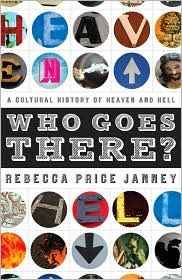
Who Goes Where There: A Cultural History of Heaven and Hell (Review)

When reviewing a book, there are many questions that I ask whilst reading. Some examples:
What is the author's thesis?
Does the author effectively work from/towards that thesis?
For what audience is the book best suited?
What are the negatives and positives about the work?
And what/how does this book add to the ongoing dialog of the Christian faith?

In Rebecca Price Janney's Who Goes there: A Cultural History of Heaven and Hell, I felt that her premise was 2 fold. One, to explore the attitudes of Heaven and Hell during different time periods in our nation; and two, to explore WHY the attitudes and theologies have changed over time. I have mixed opinions about whether she achieved these objectives or not. I think that she began this book with those two premises in mind, but quickly lets it give way to concluding that most people simply have poor theology on Heaven and Hell, and it has been that way for a while!

I'll begin with premise #1. Janney gives an American snapshot of the trend in our history to change our opinions on the subjects of the afterlife. She is very unbiased towards the fact that there was once a time when the majority (and I question her use of the word "majority") had "solid theology" on the subjects of Heaven and Hell. When was this time? Well it was none other than The First Great Awakening. Known for such tent/traveling preachers as Wesley, Whitefield, and Edwards, this was a booming time of what has become known as "Hell-fire and Brimstone Preaching". These preachers would come into town, set up shop, and people would flock to these events and buy whatever was being sold. I say that tongue-in-cheek, but let's think a little about the lifestyle of that time period.

Moral was low, the death-rate was high, all day was spent working (usually manual labor), and money was scarce among the masses. Who can blame people for flocking to an invitation given by one of these great orators that either 1) played on their already present fears, or 2) gave them a beacon of hope. People were wooed by these educated preachers because education was also poor in America at this time. It's not that dumb people fall for these messages, in fact I think it is that these average people longed for better understanding and education and "learned" from these people these doctrines they were pandering. Who would blame them? It makes complete sense that people thought more about Heaven and Hell at this point in time than any other since.

But for Janney, those were the "good old days". Americans have produced nothing but poor views on the subjects since. She chastises those who's understanding of Heaven is that "everyone good gets to go, except child-molesters and Hitler." I started thinking about this and I have to say, in all my years involved with churches and my time in ministry, I have NEVER once even heard a preacher say at a funeral, "well, Clive was a good guy, but since he never accepted Christ.... well, Clive's off to Hell now." It's not just the American populace and laity that think that people deserve to go to Heaven, even some of the most conservative ministers deep down do not act this out practically. Only when it is a concept from behind a pulpit, when we don't put faces to the concepts (except Hitler?!) is this taught with the utmost certainty.

But Janney doesn't mention this. And because she fails to accurately discover why most people's theology on the afterlife have changed, I feel that this book is truly not worth the read. Please understand, it has nothing to do with whether or not I agree with her theology on the subject! I don't recommend this book to anyone because she doesn't stay on her thesis, she is completely biased to the fact that any theology but her own is poor, and she truly misses out on a fantastic opportunity presented by this book. That opportunity comes with my last question I ask of a work:

What or how does this add to the ongoing conversation in our Christian faith?

I think that there are 2 thoughts that I conceived from this book.
1) There is a trend by many Christians, especially postmodern Christians, to NOT talk about the afterlife. I don't think its fair to say that theology has gotten weak, in fact, there has been some great theological thoughts on Salvation and the afterlife (both new and reclaimed) that has come out of this shift. But since the Heaven/Hell theology has been forced down many people's throats at the expense of equally important messages of Christ, there is a tendency to shy away from talking about or tackling the questions that people still have about the afterlife. We must focus on a holistic view of following Christ, and that means not ignoring any of these issues about which the Bible speaks. Janney, sort-of leads the reader to this conclusion, but sacrifices the calmer message for that of denouncing any theory of the afterlife except for the single one to which she herself adheres.

2) I think this is the more important question that Janney totally misses her opportunity on. When you have billions of people in the world, (Janney never really looks past the American geographical boundaries, but the phenomenon of which she speaks is world-wide) and over the past 100 years (or more) this idea of a different Heaven has emerged and held tight: the idea that it isn't about accepting Christ, but something bigger. That Heaven is a place that people deserve after the hell of this life, or because they are good people, or the myriad of the other beliefs out there. When are we going to let these theological concepts (and yes they can be considered theology, that one branch of Christianity does not have a patent on thinking about Heaven and Hell) dialog with more "traditional" ideas of the afterlife? If we believe that God is still at work and revealing himself...if we believe that theology is as Daniel Migliore defines it: "Faith seeking understanding," then we owe it to our own beliefs and certainties to face these challenging thoughts and questions. Who knows where it will lead us? I think we would find that these thoughts are far from "poor theology", and in fact, be shocked to find how well thought out and developed these ideas are.

When we push people and thoughts like this aside for our own "certainty", we miss out on many opportunities. I think this sums up Janney's book...a missed opportunity!

Find more reviews here!
Previous post w/ media here!

Feel free to leave any thoughts!

Monday, April 13, 2009


Jeffrey C. Pugh Speaks to my boy Tripp Fuller about his new book: Religionless Christianity: Dietrich Bonhoeffer In Troubled Times. I think this is a great podcast that you should listen to. Done with the love and care of all of Homebrewed's podcasts, this one shifts some thoughts about Bonhoeffer's genius and how it would apply today in a post-Christian shift.


A thought-provoking and challenging series of thoughts!

Tuesday, April 07, 2009

Jesus, Interrupted (Preview)

Dr. Bart Ehrman, professor of Religious Studies at UNC Chapel Hill, has written several books that often cause a lot of conversation (and sometimes controversy) over the years. My first experience with him was reading Lost Scriptures (and its companion Lost Christianites) in my New Testament class. He deals with the books and manuscripts left behind in the canonization process of the NT. This book was an eye-opener for me because it made me (and through me, my class) ask the question, who gets to choose which version of Christianity "makes it" into the bible. There are many other traditions in our early Christian history that have all but been silenced though the canonization. One big question that this book made us wrestle with was, "did in fact the 'winners' get to choose our Christian beliefs, and what did we lose when we lost the views of the 'losers'?" Now many people will argue (and have argued...a lot!) that the process (which was messy and happened over a long period of time) brought forth the "true" scriptures and the heretical scriptures were weeded out. After reading many of those "weeded out" texts one begins to wonder what exactly we have lost in declaring them the "losers"? In essence, at that period in our history all of these groups and writings were struggling with the same questions: "Who was Jesus?", "Who are we as followers of Christ?" and "What exactly does it mean to be 'the Church'?". The answers may vary, but the questions are some of the same questions we struggle with today!

Among Ehrman's other publications, his most talked about have been Misquoting Jesus, where he explores the translation and preservation (copying) process and how that has impacted the Bibles we hold today. He sheds light on how messy and inexact the process is, and how what we read may not have been in the original texts.

His last book, God's Problem, dealt with the questions of pain, suffering and evil and how it is or isn't present in the Bible. Both of these books have brought equal amounts of praise and scorn from their readers. However, What I admire most about Ehrman, is that he brings these issues, which are commonly talked about in the world of Christian academia, and delivers them to the pews. Many people who read these publications (which are highly accessible to the average reader) are forced to ask, "is this true?" and, "Why have I never heard this talked about in church before?". Ehrman peels off the outer layers of the surface religion that is so common in American Christianity, and forces the reader to encounter, question (I would argue in a good way), and converse with the deeper parts of their own faith, assumptions, and beliefs. While I myself may not always agree with his conclusions, I highly respect and encourage his works and the dialog opportunities that they offer!

His newest book, Jesus, Interrupted: Revealing the Hidden Contradictions in the Bible (And Why We Don’t Know About Them), is on its way via snail mail, and I will be reviewing it within a month of receiving. Until then, as with the last post, I offer these materials to help get us all pumped for the book.

This is a blogalouge debate on the problem of pain and suffering between Ehrman and NT Wright, also a revered New Testament Scholar.
This is a video:


And if all that doesn't tide you over, I don't know what will.
What are your thoughts on the books you've read by Dr. Ehrman?

UPDATE: New Media
Ehrman's Interview on Colbert
The Colbert ReportMon - Thurs 11:30pm / 10:30c
Bart Ehrman
colbertnation.com
Colbert Report Full EpisodesPolitical HumorNASA Name Contest

An Ooze.com Viral Blogger post.

Wednesday, April 01, 2009

Is The Economic Crisis Good For America?

First off I want to apologize for not posting the last 2 weeks. Believe it or not, I've been doing A LOT of thinking and writing (in note form), but have not had time to really sit down and hammer out my thoughts in an a more reader friendly format. Don't worry, I have much on mind that I hope I catch up on here soon. Interestingly enough, a lot of the thoughts I have are all converging. Once I am ready to tackle these thoughts, new ideas and/or circumstances cause me to take a step back and ponder more!
---__---

The center of a lot of my thinking of late centers around the global issues that plague our world. With issues like global poverty, hunger, war, social justice, oppression, slavery, etc... always near the front of my mind, I have found myself thinking less about what we/I can do (even though that is always a big concern for me) and more about what causes and perpetuates these problems. This has a lot to do with our Bible Study Community reading and discussing Brian McLaren's Everything Must Change. In this book he tackles the systems that keep us from solving these global problems. More on that in another post.

With this at the front of my mind, along with the economic situation, I see this week's Time
Magazine with the cover story, "The End of Excess: Why This Crisis is Good For America" (click on link to read the full article). There are some interesting things pointed out.
We saw what was happening for years, for decades, but we ignored it or shrugged it off, preferring to imagine that we weren't really headed over the falls.....Even smart, proudly rational people engaged in magical thinking, acting as if the new power of the Internet and its New Economy would miraculously make everything copacetic again. We all clapped our hands and believed in fairies.
The popular culture tried to warn us. For 20 years, we've had Homer Simpson's spot-on caricature of the quintessential American: childish, irresponsible, willfully oblivious, fat and happy. And more recently we winced at the ultra-Homerized former earthlings of WALL•E.
The article goes on to say:
We are like substance abusers coming off a long bender, hitting bottom (we can only hope) and taking the messes we've made as a sobering wake-up call. I've always thought many of the 12 Steps were superfluous, so here is a streamlined, secularized Three-Step Program for America — Bubbleholics Anonymous? — to start getting back on track:

• Admit that we are powerless over addiction to easy money and cheap fossil fuel and living large — that our lives had become unmanageable.

• Believe that we can, individually and collectively, restore ourselves to sanity and normal living.

• Make a searching and fearless moral inventory of ourselves and be entirely ready to remove our defects of character.
Unfortunately, those steps are only a start, but the article shines with hope...at least for some people. Others (the addicts that are in denial or want to remain addicted to our "prosperity, security, and equity systems" (EMC)) will find this a judgement of damnation in their lives. For me, although this economic crisis hurts, (I like my comfortable consumerist life), I see a hope that this is the breaking down of those addictive systems. I hope that this helps break us out of our collective greed bubble and will help us focus on the role we, as the wealthiest nation in the world, can play in solving these global crises.

We've already seen it. When gas prices get too high we start looking into more affordable vehicles and learn about our carbon footprint and begin to focus on the environment. However, as gas prices dropped, we once again looked longingly at the newest H2. No, our addictions are much deeper and a bigger intervention is required. Perhaps an economic meltdown is the kind of intervention we need! Trust me... it hurts me to say that. It also scares the living snot out of me!

However, we can do it...."Yes we can!" We can break free of our suicidal systems and addictive habits and begin to see past ourselves into a bigger world; a world where there are a LOT of issues that we need to deal with. Its not just about helping others, its about helping ourselves. Its about working for the good of the collective, not just working for our own good.

Poverty, AIDS, Hunger, War and Peace, Social Justice, Equality, the Environment, Etc...

These are American issues. By that I mean these are issues about which Americans should be concerned. By ignoring these issues and denying "the American dream" ideal to the world, we have lost our own identity as a great country!

These are also spiritual issues! While we've been in our own secure little bubble where our biggest concern is safeguarding ourselves at the expense of others, we've been losing our very soul! We would sell the very essence of who we are...who we are created to be. All for excess. How? Because we are all connected. we are connected to the abused, malnourished, mistreated, and alienated human-beings that we've all been ignoring for far too long. We are all created in the image of God...referred to as the children of God. Yet we've been ignoring our own siblings.

This is why I see hope in this article. Don't question my patriotism, I love America! But perhaps this is the kick in the pants we all need to see past ourselves and to begin living for something other than ourselves...something BIGGER than ourselves!

What are your thoughts?

Friday, March 13, 2009

QotW

Several "Quotes of the week" that I really like

first from U2's new CD No Line ON The Horizon
I can stand up for hope, faith, love
But while I’m getting over certainty
Stop helping God across the road like a little old lady

Out from under your beds
C’mon ye people
Stand up for your love

Love love love love love…

I gotta stand up to ego but my ego’s not really the enemy
It’s like a small child crossing an eight lane highway
On a voyage of discovery
Also:
Its not if I believe in love
If love believes in me
And from John Philip Newell
I do not believe that the gospel, which literally means "good news," is given to tell us that we have failed or been false. That is not news, and it is not good. We already know much of that about ourselves. We know we have been false, even to those whom we most love in our lives and would most want to be true to. We know we have failed people and whole nations throughout the world today, who are suffering or who are subjected to terrible injustices that we could do more to prevent. So the gospel is not given to tell us what we already know.

Rather, the gospel is given to tell us what we do not know or what we have forgotten, and that is who we are, sons and daughters of the One from whom all things come. It is when we begin to remember who we are, and who all people truly are, that we will begin to remember also what we should be doing and how we should be relating to one another as individuals and as nations and as an entire earth community."
(This came from a response to Tony Jones' Blog Post)
Just some thoughts to think about!

Thursday, March 12, 2009

Exploring Framing Stories(Part 3): Where do they come from?

I was recently asked, concerning my last post, to address from where framing stories come?

This is a tough question to answer in the confines of a blog post, so know that this is not comprehensive. However this should give one a good idea. Let's take a step back away from religious framing stories for a second. EVERYONE has a framing story (or sets of framing stories) that inform and affect their lives. Our individual framing stories are a mix of genetics and environment. Our framing stories are passed down from our families, education, culture, experiences, etc...

These framing stories inform our decisions, personality, preferences, and well... everything about us. We can't escape our framing stories, for without them we wouldn't be who we are!

Now back to religious framing stories. I'm going to stick to the overly-simplistic examples used in the first post of this series: the conventional and emerging.

We develop our faith/religious framing stories as we grow up. We inherit these frames from our church experiences (or lack of), our parent's/families' faith, and the religious culture from which in which we are exposed. We also feed back into this frame and culture. It also should be mentioned that our overall framing stories impact our religious FS, and visa-verse. It is truly a tangled web. Studies show that the #1 place from which we learn our faith practices are our parental figures. Church actually appears 3rd on the list.

Please understand that a person can inherit EITHER (or any) FS, not just the conventional. It just happens that in American Christianity, the conventional FS is the one that is inherited.

However, I think that although understanding where these FS originate is important, the question that is MORE important is WHY are so many people choosing to move away from their original Framing Story?

I use the work "choose" loosely. For the majority of people it is not a conscious decision to transition from the inherited framing story into a new one. Yet many (more every day) are realizing that they are indeed emerging out of and away from their original FS. The factors that inform this happening are as complex as are the factors that make up our original FS. In fact, the easiest way to understand WHY and HOW people move away from their original FS are the SAME factors listed above that inform their original FS. What changes? The overall frame. They move away from their family, they experience new cultures and cultural surroundings. They break free of the bubble of thoughts and ideas into a new surrounding. They explore their own thoughts, world, and beliefs through higher education (not just a college degree, but education derived from new experiences). What they are finding is that the conventional FS does not do a good job addressing the "new" reality in which they now find themselves. A reality that has always been there, but was outside of their spheres of influence as a child.

There is a lot we can learn from other's FS. Everyone's journey is unique to them. The greatest thing we can do is listen and share in each other's journeys! This will help us to understand each other's FS's, and hopefully, will help churches to embrace and even encourage people to explore and question their own framing stories. The pews should no longer be a place of forced conformity, but full of people who are diverse in their experiences and FS's, willing to listen and willing to share. Otherwise, I fear that the Church will not survive, or at least thrive, as more and more people continue to move away from the conventional FS (the one that most mainstream churches cling to), towards the emerging FS that addresses their reality.